
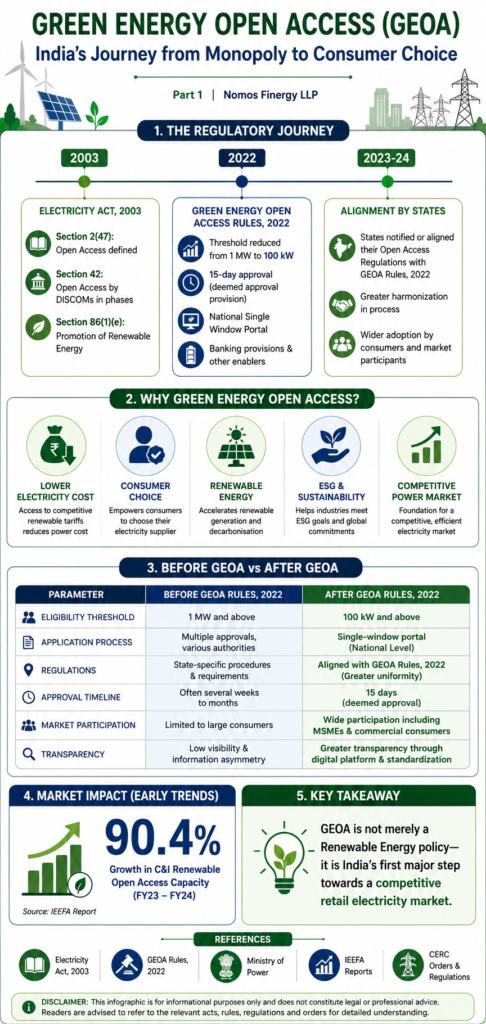
From Monopoly to Market Choice: The Regulatory Journey Towards Green Electricity
By Nomos Finergy LLP
Introduction
The Indian electricity sector is undergoing one of its most significant structural transformations since the enactment of the Electricity Act, 2003. While reforms over the last two decades introduced competition in generation and enabled power trading, the distribution segment largely remained under the control of distribution licensees (DISCOMs). Consequently, most commercial and industrial consumers continued to procure electricity from their local DISCOM, often at tariffs substantially higher than the cost of generation.
The introduction of the Electricity (Promoting Renewable Energy Through Green Energy Open Access) Rules, 2022 (“GEOA Rules, 2022“) represents a decisive policy intervention intended to change this paradigm. Instead of merely promoting renewable energy generation, the Rules seek to democratize access to renewable electricity by enabling eligible consumers to purchase green power directly from generators or through power markets.
This first part of the series examines why Green Energy Open Access became necessary, how the legal framework evolved, and whether the reform has genuinely accelerated India’s transition to a competitive green electricity market.
Frequently Used Nomenclature
| Short Form | Full Form |
|---|---|
| EA, 2003 | Electricity Act, 2003 |
| GEOA | Green Energy Open Access |
| GEOA Rules | Electricity (Promoting Renewable Energy through Green Energy Open Access) Rules, 2022 |
| DISCOM | Distribution Licensee |
| C&I | Commercial & Industrial Consumers |
| SERC | State Electricity Regulatory Commission |
| CERC | Central Electricity Regulatory Commission |
| APTEL | Appellate Tribunal for Electricity |
| RPO | Renewable Purchase Obligation |
| RE | Renewable Energy |
| CSS | Cross Subsidy Surcharge |
| AS | Additional Surcharge |
| ISTS | Inter-State Transmission System |
| GNA | General Network Access |
(These abbreviations will be used throughout the remaining parts of this series.)
Why was Green Energy Open Access Needed?
Before 2022, open access was legally available under the Electricity Act, 2003. However, in practice, several regulatory and commercial barriers significantly limited its adoption.
Major challenges included:
| Issue | Practical Impact |
|---|---|
| Minimum demand of 1 MW | Excluded a large number of medium-sized industries. |
| Different State Regulations | Each State followed different procedures, banking rules and charges. |
| Delayed approvals | Open access approvals often took several months. |
| High Cross Subsidy Surcharge | Reduced commercial attractiveness. |
| Additional Surcharge disputes | Frequent litigation before State Commissions and APTEL. |
| Banking restrictions | Renewable generators lost flexibility. |
Although the statutory right existed, effective access remained inconsistent across states.
Industry associations such as CII and FICCI repeatedly represented that renewable procurement through open access had become administratively difficult and commercially uncertain, discouraging investment in renewable power procurement.
The Legal Foundation: Electricity Act, 2003
Green Energy Open Access is not a new statutory right. Rather, it is an evolution of the open access framework established under the Electricity Act, 2003.
Section 2(47): Definition of Open Access
“Open Access means the non-discriminatory provision for the use of transmission lines or distribution system or associated facilities…”
Interpretation
This definition establishes that electricity networks are common infrastructure. The owner of the network cannot arbitrarily refuse access if statutory conditions are fulfilled.
Section 42(2)
Section 42 mandates every distribution licensee to introduce open access in phases.
It also permits recovery of:
- Cross Subsidy Surcharge (CSS)
- Additional Surcharge (AS), where applicable
Interpretation
The legislature attempted to strike a balance between:
- promoting competition; and
- protecting the financial viability of DISCOMs.
This balancing exercise continues to shape almost every open access dispute before Electricity Regulatory Commissions and APTEL.
Section 39
Section 39 imposes a similar obligation upon the State Transmission Utility to provide non-discriminatory open access.
Section 86(1)(e)
Perhaps the most important provision for renewable energy.
The State Commission shall:
“…promote cogeneration and generation of electricity from renewable sources of energy…”
This single provision became the constitutional basis upon which State Commissions framed renewable energy regulations long before the GEOA Rules were notified.
The Turning Point: Green Energy Open Access Rules, 2022
The Ministry of Power notified the Electricity (Promoting Renewable Energy through Green Energy Open Access) Rules, 2022 on 6 June 2022, exercising powers under Sections 176 and 183 of the Electricity Act, 2003. The objective was to remove barriers that had hindered renewable energy procurement through open access.
The Rules introduced several structural reforms:
| Earlier Position | GEOA Rules, 2022 |
|---|---|
| Minimum demand: 1 MW | Reduced to 100 kW |
| State-wise application process | National single-window portal |
| Approval delays | Deemed approval after 15 days, subject to prescribed conditions |
| Limited banking clarity | Banking framework recognised |
| High uncertainty in charges | Principles for transmission, wheeling, CSS, standby and banking charges specified |
The reduction of the eligibility threshold from 1 MW to 100 kW significantly expanded the potential market by allowing medium-sized commercial establishments, hospitals, educational institutions and manufacturing units to procure renewable electricity directly.
Did the Reform Work?
This is perhaps the most important question.
The answer appears to be yes—but with qualifications.
According to the Institute for Energy Economics and Financial Analysis (IEEFA):
| Indicator | Observation |
|---|---|
| Annual C&I Open Access RE Capacity | Grew by 90.4% between FY2023 and FY2024 |
| State adoption | Almost all States have initiated alignment with GEOA Rules |
| Remaining challenge | Implementation remains uneven across States |
IEEFA nevertheless observes that coordination issues between State nodal agencies and DISCOMs, along with differing interpretations of banking and charges, continue to create practical bottlenecks.
Is India Actually Transitioning to a Competitive Green Market?
The answer requires nuance.
Positive developments
 Lower eligibility threshold
Faster approvals
National portal
Growing corporate ESG commitments
Competitive renewable tariffs
Rapid increase in C&I renewable procurement
Persistent structural issues
 Banking restrictions differ across States
High CSS in several jurisdictions
Additional Surcharge disputes
Delays in operational approvals
Frequent regulatory litigation
Consequently, India has successfully created the legal architecture for Green Open Access, but the efficiency of the transition still depends heavily on State-level implementation.
Emerging Role of APTEL
Almost every major regulatory reform in the electricity sector ultimately reaches APTEL.
Although many disputes pre-date the GEOA Rules, APTEL has consistently emphasized certain guiding principles in open access jurisprudence:
- Open access is a statutory right under the Electricity Act, 2003 and cannot be defeated through administrative action.
- Charges imposed on open access consumers must have a statutory and regulatory basis.
- Regulatory Commissions must balance renewable energy promotion with the financial sustainability of distribution licensees.
- Open access restrictions cannot be arbitrary or discriminatory.
In subsequent parts of this series, we will examine landmark APTEL decisions—including disputes relating to additional surcharge, cross-subsidy surcharge, banking, captive status and renewable procurement—and analyse how these rulings have shaped the implementation of Green Energy Open Access.
Author’s Perspective
Green Energy Open Access is often presented as a renewable energy policy. That description is only partially accurate.
In reality, GEOA represents a market-design reform.
Its success should therefore not be measured solely by the number of megawatts of renewable energy added, but by whether consumers can genuinely exercise choice without facing unnecessary procedural barriers or unpredictable regulatory costs.
The coming years will determine whether India completes this transition from a DISCOM-centric electricity supply model to a consumer-centric competitive electricity market.
References
Primary Sources
2. Press Information Bureau – Green Energy Open Access Rules, 2022 Overview
Regulatory & Research References
- IEEFA Report: Impact of Green Energy Open Access Rules, 2022
- Green Open Access Registry – State Regulations Repository
- APTEL Judgments Database
Disclaimer
This article is intended solely for educational and informational purposes. It does not constitute legal, regulatory, financial or commercial advice. Although every effort has been made to rely upon authentic statutory provisions, government notifications, regulatory documents and judicial decisions available at the time of writing, readers should verify the latest amendments, regulations and judicial pronouncements before acting upon any information contained herein. The interpretations expressed are those of the author and are intended to encourage informed discussion on India’s evolving electricity market framework.