
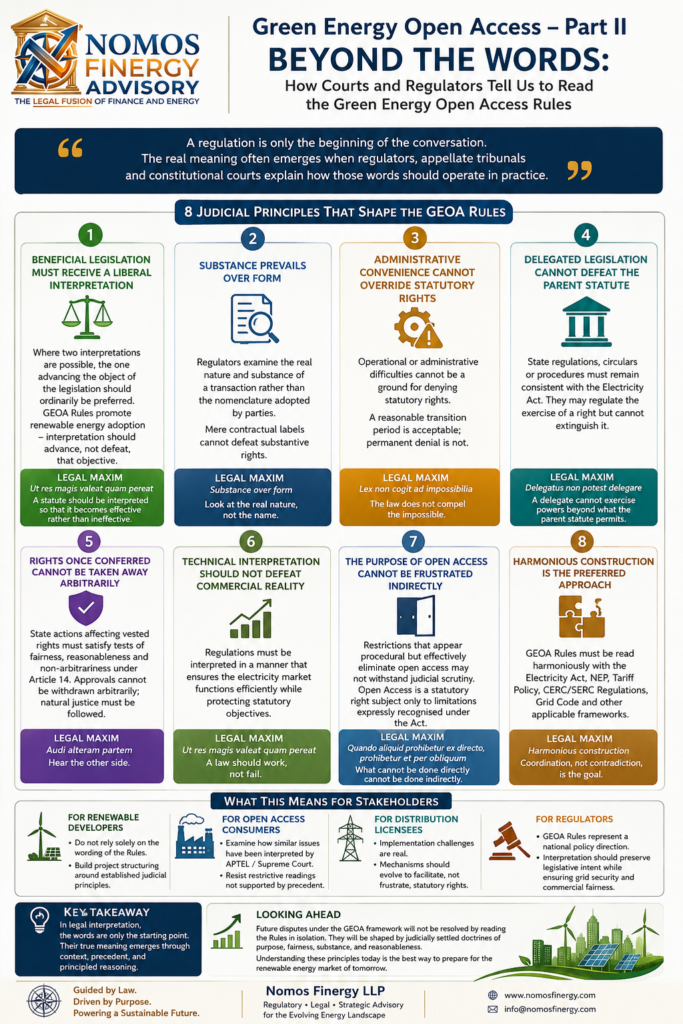
Beyond the Words: How Courts and Regulators Tell Us to Read the Green Energy Open Access Rules
The Green Energy Open Access (GEOA) Rules, 2022 represent one of the most significant reforms introduced under the Electricity Act, 2003. They seek to democratize access to renewable energy by allowing consumers to procure green power across the country through open access mechanisms. However, like every regulatory instrument, the GEOA Rules cannot be understood merely by reading their text in isolation. Their true meaning emerges when they are interpreted in the light of judicial principles developed by the Supreme Court of India, the Appellate Tribunal for Electricity (APTEL), and various Electricity Regulatory Commissions.
Electricity regulation is a dynamic interaction between statutory provisions, delegated legislation, commercial realities and constitutional principles. Consequently, whenever ambiguity arises, courts do not merely examine the literal language of a rule. Instead, they apply well-established principles of statutory interpretation to determine how the legislation should operate in practice.
The following judicial doctrines provide the interpretative framework within which the GEOA Rules must be understood.
1. Beneficial Legislation Must Receive a Liberal Interpretation
One of the oldest principles of statutory interpretation is that legislation enacted to promote a public objective should receive a purposive and liberal construction.
The GEOA Rules were introduced with a clear legislative objective—to promote renewable energy adoption, increase consumer choice, facilitate competition and contribute towards India’s energy transition. Therefore, where two interpretations of a provision are reasonably possible, courts ordinarily prefer the interpretation that advances these objectives rather than one that frustrates them.
The Supreme Court has repeatedly held that beneficial legislation should not be interpreted in a manner that defeats its own purpose. Similar reasoning has frequently been adopted by APTEL while interpreting provisions intended to encourage competition, open access and renewable energy development.
Legal Maxim
Ut res magis valeat quam pereat — A statute should be interpreted so that it becomes effective rather than ineffective.
Application under GEOA
For example, procedural requirements relating to applications, timelines or documentation should ordinarily be interpreted as facilitating access rather than creating unnecessary barriers unless the statute expressly intends otherwise.
2. Substance Prevails Over Form
Electricity regulators consistently look beyond labels adopted by parties and examine the real commercial substance of a transaction.
Whether a contract is called a power purchase agreement, banking arrangement, captive supply or group captive structure is not determinative. What matters is the underlying economic reality.
Both CERC and APTEL have repeatedly emphasized that regulatory rights and obligations cannot be altered merely through contractual drafting. If the substance of a transaction attracts a particular regulatory framework, parties cannot escape that framework by adopting different terminology.
This principle assumes particular significance under GEOA where questions frequently arise regarding captive consumption, green energy procurement structures, banking arrangements and renewable supply models.
Legal Maxim
Substance over form.
The law regulates the true nature of the transaction, not merely its nomenclature.
3. Administrative Convenience Cannot Override Statutory Rights
Distribution licensees often face genuine operational challenges in implementing open access. Network constraints, metering arrangements, scheduling systems and software integration may require transitional adjustments.
However, judicial precedents consistently distinguish between temporary implementation challenges and permanent denial of statutory rights.
Administrative inconvenience cannot become a legal justification for refusing rights expressly conferred by Parliament.
The Supreme Court has repeatedly held that executive authorities cannot refuse statutory benefits merely because implementation is difficult. APTEL has similarly observed that operational issues should be resolved through regulatory mechanisms rather than by denying consumer rights.
Reasonable transition periods may be justified. Permanent restrictions generally are not.
Legal Maxim
Lex non cogit ad impossibilia — The law does not compel the impossible.
The principle recognizes practical limitations, but it does not authorize indefinite suspension of statutory rights.
4. Delegated Legislation Cannot Defeat the Parent Statute
The GEOA Rules derive their authority from the Electricity Act, 2003. Likewise, State Regulations derive their authority from both the Act and the Rules.
A fundamental constitutional principle is that subordinate legislation cannot override, dilute or defeat the parent legislation from which it derives its existence.
The Supreme Court has consistently held that delegated legislation must remain within the boundaries established by Parliament. If any regulation, circular, guideline or administrative instruction imposes restrictions inconsistent with the parent Act, such subordinate legislation becomes vulnerable to judicial review.
Accordingly, State Commissions possess ample authority to regulate the manner in which open access is implemented, but they cannot extinguish or substantially dilute the statutory right itself.
Legal Maxim
Delegatus non potest delegare.
A delegate cannot exercise powers beyond those conferred by the parent legislation.
5. Rights Once Conferred Cannot Be Taken Away Arbitrarily
Article 14 of the Constitution guarantees fairness, reasonableness and protection against arbitrary state action.
Once approvals are granted or statutory rights accrue, they cannot be withdrawn without following principles of natural justice.
The Supreme Court has consistently held that administrative decisions affecting vested rights require transparency, fairness and an opportunity of hearing. Similar principles have guided electricity regulatory jurisprudence, where cancellation or modification of approvals must satisfy standards of procedural fairness.
This doctrine is particularly relevant where open access permissions, banking approvals or connectivity permissions are sought to be withdrawn without adequate justification.
Legal Maxim
Audi alteram partem.
Hear the other side before taking a decision.
6. Technical Interpretation Should Not Defeat Commercial Reality
Electricity markets function through complex technical systems involving scheduling, balancing, forecasting, settlement and transmission operations.
Judicial bodies recognize that regulations must be interpreted in a manner that enables efficient market functioning while simultaneously protecting statutory objectives.
An interpretation that appears technically correct but produces commercially irrational outcomes is generally avoided.
APTEL has repeatedly emphasized that regulatory interpretation should encourage efficiency, competition and market development rather than create avoidable commercial distortions.
This principle assumes increasing importance as renewable integration expands and market-based procurement mechanisms become more sophisticated.
Legal Maxim
Ut res magis valeat quam pereat.
A law should function effectively in practice rather than fail because of overly technical interpretation.
7. The Purpose of Open Access Cannot Be Frustrated Indirectly
A recurring principle in constitutional jurisprudence is that what cannot be done directly cannot be achieved indirectly.
If Parliament has recognized open access as a statutory right, regulators cannot impose procedural conditions whose cumulative effect is to render that right illusory.
Courts examine not merely the wording of restrictions but also their practical consequences.
For example, repeated procedural delays, excessive documentation, unreasonable conditions or indefinite processing timelines may collectively frustrate the legislative purpose even if each individual requirement appears facially valid.
The judiciary therefore looks beyond form and asks a fundamental question:
Does the regulatory framework facilitate the exercise of the statutory right or effectively prevent it?
Legal Maxim
Quando aliquid prohibetur ex directo, prohibetur et per obliquum.
What cannot be done directly cannot be done indirectly.
8. Harmonious Construction Is the Preferred Approach
The GEOA Rules do not exist independently.
They operate alongside the Electricity Act, 2003, the National Electricity Policy, Tariff Policy, CERC Regulations, State Regulations, the Grid Code, Connectivity Regulations and numerous technical standards.
Whenever apparent conflicts arise, courts attempt to harmonize these instruments rather than interpret one in isolation.
The Supreme Court has consistently held that statutes forming part of the same legislative framework should be read together so that each provision is given meaningful effect.
Accordingly, interpretation of the GEOA Rules requires examining the broader regulatory ecosystem instead of focusing exclusively on individual clauses.
Legal Maxim
Harmonious construction.
The objective is coordination rather than contradiction.
Judicial Trends in Electricity Regulation
Although many disputes arise from specific regulatory provisions, the broader judicial trend remains remarkably consistent.
Courts and APTEL generally avoid interpretations that:
- Defeat the legislative objective of promoting competition.
- Render statutory rights ineffective.
- Elevate procedural formalities above substantive justice.
- Permit delegated legislation to override Parliament’s intent.
- Encourage arbitrary administrative action.
- Produce commercially irrational outcomes.
Instead, judicial reasoning consistently favails interpretations that preserve market efficiency, consumer choice, renewable energy development and regulatory certainty.
Practical Implications for Stakeholders
The interpretative principles discussed above have practical significance for every participant in the electricity sector.
Renewable Energy Developers should structure projects keeping in mind not only the literal wording of the Rules but also established judicial doctrines governing statutory interpretation.
Open Access Consumers should assess regulatory restrictions in the light of judicial precedent. Not every administrative condition necessarily possesses statutory validity.
Distribution Licensees should design implementation mechanisms that facilitate rather than frustrate statutory rights while maintaining grid security and operational reliability.
Regulators must balance technical requirements with the legislative objective of promoting green energy markets. Judicial review increasingly focuses upon whether regulations preserve the purpose of the parent legislation.
Conclusion
The Green Energy Open Access Rules are only the starting point of the legal analysis. Their practical operation depends upon decades of jurisprudence developed under the Electricity Act, constitutional law and administrative law.
Every significant regulatory question ultimately requires answering not only “What does the Rule say?” but also “How have courts instructed us to interpret such a Rule?”
That distinction is crucial. Words provide the framework; judicial interpretation gives those words legal life. For stakeholders navigating India’s evolving renewable energy market, understanding these principles is therefore not an academic exercise—it is an operational necessity.
As the GEOA framework continues to evolve, future disputes will increasingly be resolved through these enduring principles of purposive interpretation, fairness, proportionality and statutory harmony. Those who understand this jurisprudential foundation will be better equipped to anticipate regulatory outcomes, structure compliant transactions and safeguard their statutory rights in India’s rapidly expanding green electricity ecosystem.
Disclaimer
This article is published by Nomos Finergy LLP solely for educational, informational and knowledge-sharing purposes. The views expressed herein are based on the authors’ understanding of the Electricity Act, 2003, the Green Energy Open Access Rules, 2022, applicable regulations, and judicial precedents available as on the date of publication.
The discussion is intended to provide a conceptual understanding of the legal principles governing the interpretation of the Green Energy Open Access framework. It should not be construed as legal advice, regulatory advice, financial advice, or a professional opinion on any specific transaction, dispute or regulatory proceeding.
Judicial decisions and regulatory interpretations are inherently fact-specific. The applicability of any principle discussed in this article may vary depending upon the facts of a particular case, subsequent legislative amendments, regulatory changes, or later judicial pronouncements. Readers are advised to independently verify the current legal and regulatory position and seek appropriate professional advice before acting upon any information contained herein.
While every effort has been made to ensure the accuracy and reliability of the information presented, Nomos Finergy LLP, its partners, associates and contributors do not accept any liability for any loss or damage arising from reliance on this publication.
© NomosFinergy LLP. All rights reserved.