
TARIFF & STRATEGY

Tariff petition cycle
The MYT petition establishes the Aggregate Revenue Requirement (ARR), which represents the total revenue the utility must recover to remain financially viable.
- Preparation and Filing of the Tariff Petition
The process begins with the preparation of a tariff petition, typically under the Multi-Year Tariff (MYT) framework, which establishes the utility’s Aggregate Revenue Requirement (ARR) for the control period.
The petition integrates operational, financial, and engineering information including:
- capital investment plans
- power purchase cost projections
- operation and maintenance expenses
- depreciation and financing costs
- regulatory norms such as return on equity and performance parameters
Consultant’s value addition
At this stage, consultants assist utilities in:
- translating operational data into regulatory formats
- aligning financial projections with regulatory norms and precedents
- identifying cost elements that require stronger justification
- ensuring consistency between financial statements, operational data, and regulatory filings
A properly structured petition reduces the risk of cost disallowances during regulatory scrutiny.
- Admission of Petition and Stakeholder Consultation
Once filed, the Commission admits the petition and directs the utility to publish a public notice inviting objections and suggestions from stakeholders. This step reflects the transparent and participatory nature of electricity tariff regulation.
Consumer groups, industry associations, and other market participants may submit comments challenging aspects of the petition, including:
- capital expenditure proposals
- power procurement strategies
- efficiency of operational costs
- tariff impact on consumers
Consultant’s value addition
Consultants assist in preparing detailed written replies addressing these objections with technical data, financial explanations, and regulatory references. Where stakeholders submit additional arguments, consultants prepare rejoinders to clarify the utility’s position and prevent misinterpretation of data or regulatory provisions.
This stage is critical because the written submissions form the record on which the Commission evaluates competing viewpoints.
- Regulatory Scrutiny and Prudence Check
Before approving costs for recovery through tariffs, regulators conduct a prudence check to ensure that only efficiently incurred expenses are passed on to consumers.
Two areas receive particularly detailed scrutiny:
Capital Expenditure (CAPEX)
The Commission examines whether infrastructure investments—such as transmission expansion, network strengthening, or metering programmes—are necessary, efficiently implemented, and aligned with approved planning frameworks.
Power Purchase Costs
For distribution utilities, power procurement represents the largest cost component. Regulators therefore assess whether electricity has been procured through economically justified arrangements and whether contracted capacity reflects realistic demand requirements.
Consultants help utilities:
- prepare detailed justifications for capital investments
- demonstrate prudence in procurement decisions
- present benchmarking and regulatory precedents supporting the cost claims
- respond to data queries from regulatory staff
Proper handling of this stage helps prevent partial cost disallowances that could affect the utility’s financial viability.
- Public Hearings and Oral Representation
In most tariff proceedings, the Commission conducts public hearings, where utilities and stakeholders present their arguments before the Commission.
These hearings allow Commissioners to directly question assumptions underlying the petition and seek clarification on financial projections, operational performance, or regulatory interpretations.
Consultant’s value addition
Consultants support utilities by:
- preparing structured presentations for the hearing
- Responding to technical and financial queries on behalf of management.
- explaining complex engineering or cost assumptions in clear regulatory language
Effective representation during hearings helps ensure that the Commission fully understands the technical and financial rationale behind the utility’s claims.
- Tariff Order and Revenue Determination
After examining the petition, stakeholder submissions, replies, rejoinders, and oral arguments, the Commission issues a Tariff Order determining the allowable revenue and the tariffs applicable to different consumer categories.
The order may approve, modify, or disallow specific cost elements depending on the Commission’s assessment of prudence and regulatory compliance.
Consultant’s value addition
Consultants assist utilities in:
- analyzing the financial implications of the tariff order
- identifying regulatory directions requiring compliance
- preparing strategies for implementation of the new tariff structure
- Truing Up and Periodic Adjustments
Since tariff orders are based on projections, regulators subsequently conduct Truing-Up exercises to reconcile projected values with actual audited performance.
Utilities must justify deviations between projections and actual results, particularly with respect to fuel costs, power procurement, and operational efficiency.
In addition, mechanisms such as Fuel Cost Adjustment (FCA/FPPCA) allow periodic recovery of fluctuations in input costs.
Consultant’s value addition
Consultants support utilities by:
- preparing truing-up petitions based on audited accounts
- demonstrating whether deviations arise from controllable or uncontrollable factors
- ensuring recovery of legitimate cost variations through regulatory mechanisms
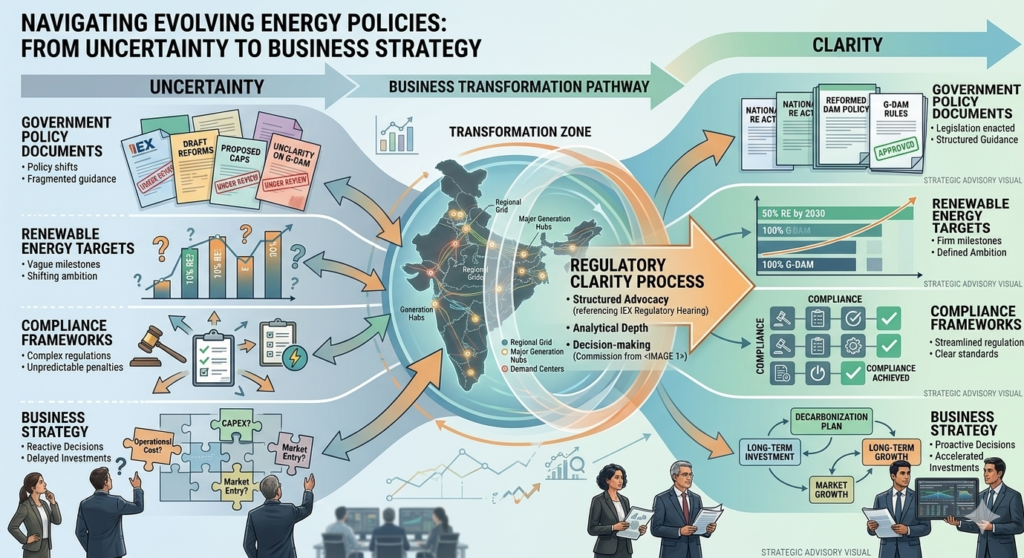
STRATEGIC MARKET ADVISORY
Beyond regulatory advisory, our consulting services extend into financial structuring, commercial strategy, market participation, and emerging energy transition opportunities. Power sector investments are capital-intensive and operate over long asset lifecycles, making outcomes highly sensitive to initial structuring, revenue visibility, and market alignment.
We support developers, investors, utilities, and large consumers in designing bankable project structures and robust financial models that integrate engineering parameters, capital structures, regulatory constructs, and forward market price signals. This enables informed decision-making and enhances the long-term sustainability of investments.
Our strategic advisory further encompasses market-facing solutions, including optimization of power sales across long-term PPAs, short-term markets, and exchange-based mechanisms, aligned with evolving market dynamics.
With the growing importance of decarbonization, we provide advisory in carbon market participation and monetization strategies, including identification of eligible mechanisms, revenue modelling from carbon credits, and integration of carbon value streams into project economics.
We also advise on Battery Energy Storage Systems (BESS) as a critical enabler for grid flexibility and market participation. Our services cover techno-commercial evaluation, revenue stacking strategies (arbitrage, ancillary services, peak management), and integration of storage into generation and consumption portfolios.
Overall, our approach brings together technical, financial, and market intelligence into a unified framework, enabling clients to navigate complexity, unlock value, and position assets competitively in a rapidly evolving power market.
Financial Viability and Investment Assessment
A core element of project advisory is the development of robust financial models that project revenues, costs, and financing obligations over the life of the asset.
These models evaluate key financial indicators that determine the bankability and attractiveness of the project, including:
Project Internal Rate of Return (Project IRR)
An indicator of the overall profitability of the project based on projected cash flows throughout its operational life.
Net Present Value (NPV)
A valuation measure that determines whether the discounted future cash flows of the project exceed the initial investment.
Equity Internal Rate of Return (Equity IRR)
Represents the return earned specifically by equity investors after servicing debt obligations and financing costs.
Payback Period
Estimates the time required for investors to recover the initial capital invested in the project.
Debt Service Coverage Ratio (DSCR)
A key financial metric used by lenders to assess whether project revenues are sufficient to meet debt repayment obligations.
Through such analysis, consultants help determine whether a project satisfies the risk-return expectations of investors while meeting the bankability criteria required by lenders and financial institutions.
Cost Structure Analysis and Risk Evaluation
Financial projections are complemented by detailed evaluation of the underlying cost structure and operational assumptions of the project. Consultants examine factors such as:
- long-term operation and maintenance (O&M) cost projections
- regulatory norms governing cost escalation and performance parameters
- fuel supply arrangements and price risks where applicable
- long-term electricity demand outlook and price expectations
Sensitivity analysis is often performed to assess the impact of changes in key variables—such as fuel costs, plant availability, or market prices—on overall project returns.Revenue Structuring and Power Sale Strategy
The commercial viability of a generation project depends fundamentally on the structure through which electricity generated by the plant is sold. Consultants therefore advise developers on designing revenue strategies that balance income stability with market opportunities.
One approach involves securing long-term revenue through Power Purchase Agreements (PPAs) with utilities, distribution companies, or large consumers. These contracts typically provide predictable revenue streams and are often essential for securing project financing.
At the same time, modern electricity markets allow generators to monetize additional capacity through organized power markets and competitive trading platforms. Consultants therefore evaluate the role that market-based sales can play alongside contractual arrangements in optimizing project revenues.
Preparation and Negotiation of Power Purchase Agreements
The Power Purchase Agreement (PPA) forms the cornerstone of commercial arrangements in the electricity sector, defining the contractual relationship between the power generator and the purchasing entity.
Consultants assist clients throughout the lifecycle of PPA development and negotiation by:
- preparing and structuring draft agreements
- advising on tariff structures, capacity charges, and energy charges
- ensuring alignment with applicable regulatory provisions
- supporting negotiations with procuring utilities or power buyers
Consultants also participate in discussions concerning key commercial and operational provisions, including:
- scheduling and dispatch obligations
- payment security mechanisms
- fuel cost pass-through provisions
- change-in-law protections
- force majeure clauses and dispute resolution mechanisms
Where required, draft agreements are coordinated for independent legal vetting by specialized legal consultants, ensuring that the final contract remains both commercially balanced and legally enforceable.
Market Participation and Pricing Strategy
With the evolution of organized electricity markets, generators increasingly require strategies to participate effectively in competitive trading platforms such as those operated by Indian Energy Exchange and Power Exchange India Limited.
Consultants therefore provide advisory services relating to market participation, price discovery, and bidding strategies, particularly for generators that have surplus capacity or flexible generation profiles.
These services may include:
Optimization of Surplus Power Sales
Thermal generating stations operating under long-term contracts may occasionally have un-requisitioned surplus (URS) capacity when procuring utilities do not schedule the full declared capacity. Consultants help design strategies to monetize such surplus power in organized markets so that generators can recover variable costs and improve plant utilization.
Short-Term Pricing Strategy for Renewable Energy
Renewable generators often face variability in output and may not always have long-term contractual arrangements covering the entire generation. Strategic participation in exchange-based markets allows these generators to sell excess generation while responding to market price signals.
Exchange Bidding Strategy
Participation in power exchanges requires careful bidding approaches to balance price realization with the probability of market clearing. Consultants assist in structuring bids such as:
- block bids for continuous time periods
- profile block bids aligned with generation patterns across the day
- strategic price bids based on anticipated demand–supply conditions
Participation in Emerging Forward and Future Markets
The Indian electricity market is gradually evolving to include forward and longer-tenure market products, allowing generators and buyers to manage price risks more effectively.
Consultants assist clients in understanding and participating in these emerging market structures by:
- evaluating forward price signals and demand expectations
- advising on participation mechanisms in exchange-based forward products
- helping design strategies to hedge market price volatility
Enabling Sustainable and Bankable Energy Investments
By integrating financial modelling, contractual structuring, regulatory awareness, and market strategy, consultants help power sector stakeholders convert project concepts into financially viable and commercially optimized energy investments.
In a sector where regulatory policy, market structures, and technology are constantly evolving, professional advisory support ensures that investors and project developers are able to secure stable revenues, manage risks effectively, and capture emerging opportunities in the evolving electricity market landscape.