
Battery Energy Storage Purchase Agreements (BESPA) :Drafting Bankable Contracts and Preventing Future Disputes
By NomosFinergy LLP
Introduction
The first two parts of this series discussed why Battery Energy Storage Systems (BESS) are required and how Electricity Regulatory Commissions (ERCs) evaluate their approval. Once a project receives regulatory approval, however, another equally important challenge begins—the drafting of the Battery Energy Storage Purchase Agreement (BESPA).
In many infrastructure projects, disputes do not arise because the technology fails; they arise because the contract fails to clearly allocate risks, responsibilities and commercial expectations. Battery storage projects are no exception. In fact, a BESPA is significantly more complex than a conventional Power Purchase Agreement (PPA), because it governs not only payment for capacity but also charging philosophy, dispatch rights, battery degradation, availability guarantees, performance standards and multiple revenue streams.
Unlike a thermal or renewable generating station, a battery does not produce electricity. It stores electricity, preserves it for a limited duration and delivers it when the grid requires flexibility. Consequently, the BESPA should be viewed not as a simple purchase agreement but as the commercial blueprint of the entire storage project.
Why is BESPA fundamentally different from a conventional PPA?
A conventional PPA revolves around one principal obligation—generation and sale of electricity. The seller undertakes to generate electricity and the procurer agrees to purchase it under agreed commercial terms.
A BESPA follows an entirely different philosophy. The developer is not selling electricity generated from its own plant. Instead, it undertakes to provide an operational service consisting of storage capacity, rapid response capability, availability and reliable dispatch whenever instructed by the procurer.
In other words,
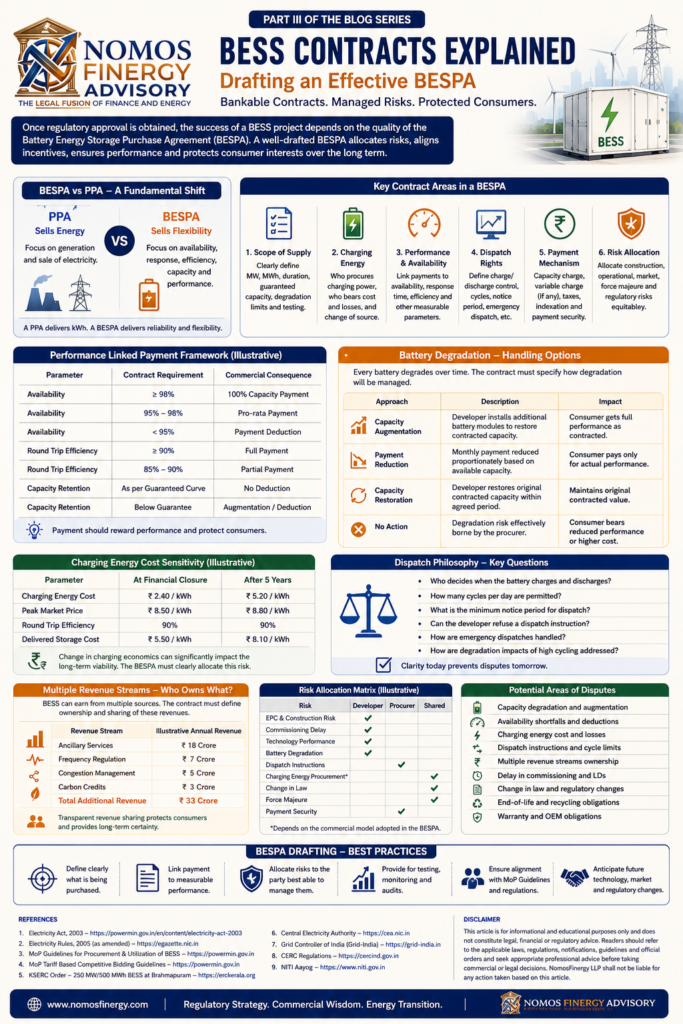
A PPA sells energy. A BESPA sells flexibility.
This distinction changes almost every commercial clause.
The First Question Every BESPA Should Answer
Before drafting payment clauses or technical specifications, the parties should first answer a deceptively simple question:
What exactly is the procurer purchasing?
Consider a hypothetical project where the developer agrees to establish a 250 MW / 500 MWh Battery Energy Storage System.
Does this mean:
- 250 MW is guaranteed only on the Commercial Operation Date (COD)?
- 500 MWh remains available throughout the contract period?
- The battery may naturally degrade without compensation?
- Capacity augmentation is mandatory if storage falls below contractual limits?
Unless these issues are expressly addressed, both parties may interpret the contract differently several years after commissioning.
Commercial Risks Begin With Charging Energy
Unlike conventional generators, batteries require electricity before they can deliver electricity. This makes charging energy one of the most critical commercial components of any BESPA.
Assume the following example:
| Parameter | At Financial Closure | After 5 Years |
|---|---|---|
| Charging Energy Cost | ₹2.40/kWh | ₹5.20/kWh |
| Peak Market Price | ₹8.50/kWh | ₹8.80/kWh |
| Delivered Storage Cost | ₹5.50/kWh | ₹8.10/kWh |
In Year One, the project is economically attractive.
By Year Five, if charging energy prices rise substantially, the economics may deteriorate significantly.
The agreement should therefore clearly identify:
- Who procures charging energy?
- Who bears charging losses?
- Can charging sources be changed?
- What happens if low-cost charging energy is no longer available?
These issues determine long-term commercial viability.
Payment Should Follow Performance
Unlike a solar plant, where payment is generally linked to scheduled energy supplied, a battery storage project derives its value from being available when required.
Consequently, monthly payments should be linked to measurable operational performance.
A suggested payment philosophy is illustrated below.
| Performance Parameter | Contract Requirement | Commercial Consequence |
|---|---|---|
| Availability | ≥98% | Full Capacity Payment |
| Availability | 95–98% | Partial Payment |
| Availability | <95% | Payment Deduction |
| Response Time | <1 second | Full Compliance |
| Round-trip Efficiency | ≥90% | Full Payment |
| Capacity Retention | As Guaranteed | Continue Payment |
Such a mechanism protects consumers while rewarding efficient operation.
Battery Degradation Requires Explicit Allocation
Every electrochemical battery loses capacity over time.
This is not a defect.
It is a normal engineering characteristic.
The commercial question is therefore not whether degradation occurs, but who bears its financial consequences.
Suppose the project begins with a guaranteed storage capacity of 500 MWh.
After seven years, testing indicates that usable capacity has reduced to 430 MWh.
Several commercial approaches are possible.
| Approach | Consequence |
|---|---|
| Capacity Augmentation | Developer installs additional battery modules |
| Payment Reduction | Monthly payment reduced proportionately |
| Capacity Restoration | Developer restores original contracted capacity |
| No Action | Consumer bears reduced performance |
Dispatch Philosophy Should Never Be Left to Interpretation
One of the most significant differences between a generating station and a battery lies in operational control.
Several practical questions arise.
Can the procurer instruct multiple charge-discharge cycles within a single day?
Can the developer refuse dispatch instructions that exceed guaranteed cycle limits?
Who determines charging schedules?
How much advance notice should be provided?
How will emergency dispatch instructions be handled?
Failure to answer these questions often leads to operational disputes after commissioning rather than during contract negotiations.
Multiple Revenue Streams Will Become the Next Major Dispute
Modern battery storage systems can provide much more than peak power support.
Depending upon market evolution, they may participate in:
- Ancillary Services
- Frequency Regulation
- Congestion Management
- Black Start Services
- Energy Arbitrage
- Capacity Markets
- Carbon Markets
This creates an entirely new commercial question.
Suppose a battery earns additional annual revenues as follows.
| Revenue Source | Annual Revenue (Illustrative) |
|---|---|
| Ancillary Services | ₹18 Crore |
| Frequency Regulation | ₹7 Crore |
| Congestion Management | ₹5 Crore |
| Carbon Credits | ₹3 Crore |
| Total Additional Revenue | ₹33 Crore |
Who should receive these revenues?
If consumers are already paying monthly capacity charges, should all additional commercial benefits belong exclusively to the developer?
Future BESPAs should clearly define revenue-sharing mechanisms.
Delay in Commissioning Has Real Economic Consequences
Unlike conventional EPC contracts, delays in battery projects directly affect system operations.
Assume that commissioning is delayed by six months.
During this period, the utility continues purchasing expensive evening power from the market.
| Item | Value |
|---|---|
| Delay | 6 Months |
| Average Peak Purchase Cost | ₹9.20/kWh |
| Additional Procurement Cost | ₹40 Crore (Illustrative) |
The BESPA should therefore incorporate milestone-based liquidated damages and measurable completion obligations.
Change in Law Should Extend Beyond Taxation
Traditional Change in Law clauses generally address taxation and statutory amendments.
Battery projects require broader consideration.
Future contractual provisions should also contemplate:
- Battery recycling regulations.
- Import restrictions on battery materials.
- Carbon market legislation.
- Cyber-security standards.
- Environmental compliance requirements.
- Safety regulations.
- Fire protection standards.
Given the rapid evolution of battery technology, contractual flexibility becomes increasingly important.
| Risk | Developer | Procurer |
|---|---|---|
| EPC Risk | ✓ | |
| Construction Delay | ✓ | |
| Technology Performance | ✓ | |
| Battery Degradation | ✓ (subject to guarantees) | |
| Dispatch Instructions | ✓ | |
| Charging Energy Procurement* | Depends on BESPA | Depends on BESPA |
| Change in Law | Shared | Shared |
| Force Majeure | Shared | Shared |
| Payment Security | ✓ |
The allocation depends on the commercial model adopted.
What Should Regulators Look For?
Although the BESPA is negotiated between commercial parties, Electricity Regulatory Commissions have a legitimate interest in ensuring that consumer interests remain protected.
Before approving procurement, a Commission may reasonably examine whether the agreement:
- Allocates risks appropriately.
- Prevents double recovery of revenues.
- Links payment with performance.
- Protects consumers against excessive degradation.
- Contains effective monitoring mechanisms.
- Includes enforceable delay provisions.
- Provides transparent testing procedures.
- Maintains long-term economic viability.
The objective is not to rewrite commercial contracts but to ensure that long-term consumer-funded investments remain prudent and sustainable.
The NomosFinergy Perspective
Battery storage projects represent one of the most sophisticated commercial arrangements in the evolving electricity sector. Their success depends not only on engineering excellence but equally on contractual clarity.
At NomosFinergy LLP, we believe that every technical assumption should have a corresponding contractual provision. Every foreseeable commercial risk should have a clearly identified owner. Every payment obligation should be linked to measurable performance. Above all, every BESPA should be drafted with the understanding that it is likely to remain in force for more than a decade, during which technology, market structures and regulations will continue to evolve.
The objective of a BESPA should therefore be much broader than enabling project execution. It should create certainty, minimise disputes, protect consumers and provide confidence to developers, lenders and regulators alike.
Conclusion
Battery Energy Storage Systems are changing the way electricity systems are planned, operated and regulated. They should also change the way infrastructure contracts are drafted.
The BESPA is not merely another procurement agreement. It is the document that determines whether a storage project remains commercially viable, technically reliable and legally sustainable throughout its operational life.
As India’s storage market expands, well-drafted BESPAs will become just as important as competitive tariffs. Projects that clearly define rights, responsibilities and risk allocation from the outset will be far better positioned to avoid litigation, attract investment and deliver lasting value to electricity consumers.
Disclaimer
The views expressed in this article are intended solely for educational, academic and professional discussion. They do not constitute legal, financial or regulatory advice. The analysis is based on the Electricity Act, 2003, the Electricity Rules, 2005 (as amended), applicable Government of India policies, publicly available regulatory orders and industry practices as of the date of publication. Readers are advised to refer to the latest statutory provisions, Government notifications, bidding guidelines, regulatory orders and contractual documents before taking any commercial or legal decisions. NomosFinergy LLP shall not be responsible for any action taken based solely on the contents of this article without obtaining appropriate professional advice.