
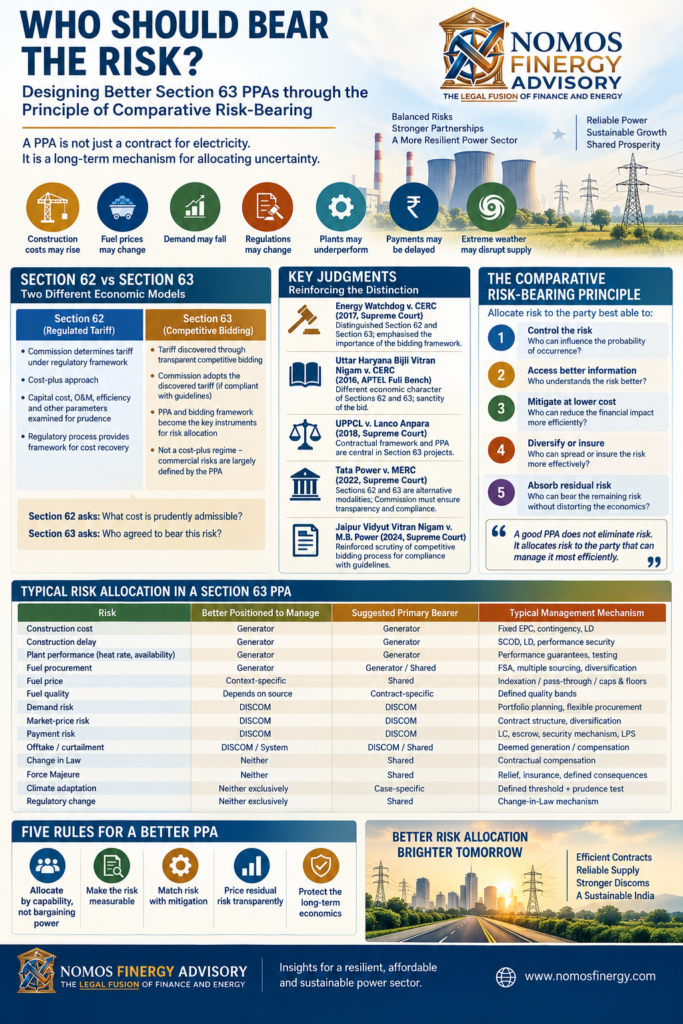
Designing Better Section 63 PPAs through the Principle of Comparative Risk-Bearing
A Power Purchase Agreement (PPA) is often viewed primarily as a contract for buying and selling electricity. But economically, it is much more than that.
A PPA is a long-term mechanism for allocating uncertainty.
Construction costs may rise. Fuel prices may change. Demand may fall. Regulations may change. Plants may underperform. Payment may be delayed. Extreme weather may disrupt supply. Market prices may move sharply.
The central question is therefore not:
How can the generator minimise its risk?
Nor is it:
How can the DISCOM transfer as much risk as possible to the generator?
The better question is:
Which party is better positioned to understand, control, mitigate, diversify or absorb each particular risk?
This distinction could provide a useful framework for designing better PPAs for competitively procured power under Section 63 of the Electricity Act, 2003.
Section 62 and Section 63: Two Different Economic Models
The distinction between Sections 62 and 63 is fundamental.
Under Section 62, the Appropriate Commission determines tariff under the regulatory framework. The process involves examination of costs, prudence checks and normative parameters.
Under Section 63, the tariff is discovered through a transparent competitive bidding process conducted in accordance with Central Government guidelines, and the Commission adopts the discovered tariff if the statutory conditions are satisfied.
The Supreme Court in Energy Watchdog v. CERC (2017) drew this distinction clearly: under Section 62, the Commission determines tariff; under Section 63, the bidding process determines the tariff and the Commission adopts it subject to the statutory conditions.
The APTEL Full Bench in Uttar Haryana Bijli Vitran Nigam Ltd. v. CERC (2016) similarly observed that Section 62 involves a cost-plus regulatory process, whereas Section 63 represents a different competitive-bidding framework. It emphasised the sanctity of the bid and observed that a Section 63 tariff cannot simply be converted into a Section 62 tariff through general regulatory powers.
The Supreme Court subsequently explained in Uttar Pradesh Power Corporation Ltd. v. Lanco Anpara Power Ltd. (2018) that where the bidding guidelines and PPA specifically deal with a matter, the contractual framework is central; relief outside the PPA cannot simply be granted by treating a competitively discovered tariff as a cost-plus tariff.
At the same time, Section 63 does not make the regulator a mere rubber stamp. In Tata Power Company Ltd. Transmission v. MERC (2022), the Supreme Court held that Sections 62 and 63 are alternative statutory modalities, and explained that under Section 63 the Commission must examine whether the bidding was transparent and compliant with the Central Government guidelines.
More recently, in Jaipur Vidyut Vitran Nigam Ltd. v. M.B. Power (2024), the Supreme Court reiterated that the Commission has a role in examining whether the competitive bidding process and tariff comply with the statutory and guideline framework.
The message from these decisions is important:
In a Section 63 project, the PPA and bidding framework acquire much greater importance in determining who bears a particular commercial risk.
From Risk Allocation to Risk Management
A conventional approach to PPA drafting asks:
“Who bears this risk?”
A better approach should ask five questions first:
- Who controls the risk?
- Who has better information about it?
- Who can mitigate it at lower cost?
- Who can diversify or insure it more efficiently?
- Who can absorb the residual risk without imposing an excessive risk premium on the other party?
Only then should the PPA determine the allocation.
This may be called the Comparative Risk-Bearing Principle.
1. Put controllable risks with the party that controls them
Construction cost and construction delay are obvious examples.
The generator controls:
- EPC selection;
- procurement;
- project management;
- technology;
- construction execution.
Therefore, the generator is generally better placed to manage construction risk.
The PPA can reinforce this through:
fixed-price EPC contracts + performance guarantees + liquidated damages + insurance + contingency planning.
The objective is not merely to transfer construction risk to the generator. It is to ensure that the risk sits with the party capable of managing it.
2. Give demand risk to the party with demand visibility
A DISCOM generally has much better information about:
- consumer demand;
- load patterns;
- industrial growth;
- rooftop solar;
- open access;
- energy efficiency;
- its existing procurement portfolio.
Therefore, long-term demand risk should ordinarily remain substantially with the DISCOM.
If the DISCOM contracts 1,000 MW for 25 years and demand subsequently falls, transferring that risk to the generator may simply increase the tariff required by the generator to compensate for the uncertainty.
The better solution may be:
portfolio diversification + flexible procurement + appropriate contract tenure + capacity flexibility.
3. Do not confuse fuel-price risk with fuel-availability risk
These are different risks.
A generator may be well placed to manage fuel procurement through:
- long-term supply contracts;
- multiple suppliers;
- inventory;
- hedging.
But a systemic shortage caused by railway disruption or a government-controlled supply constraint may be beyond its control.
Therefore, a PPA should distinguish:
commercial procurement risk
from
systemic supply disruption.
The first may appropriately remain with the generator; the second may require contractual relief, sharing or Force Majeure treatment.
4. Performance risk should normally remain with the generator
Plant efficiency, heat rate, equipment reliability and O&M performance are substantially within the generator’s sphere of influence.
Therefore, the generator should normally bear performance risk through:
- performance guarantees;
- testing procedures;
- availability requirements;
- heat-rate provisions;
- degradation standards;
- appropriate consequences for shortfall.
But the PPA must also specify the conditions under which performance is measured.
A generator cannot reasonably guarantee the same performance under fuel quality, ambient temperature or cooling-water conditions radically different from those assumed when the obligation was established.
This is where our earlier concept of a Regulatory Operating Envelope becomes useful.
The PPA Should Manage the Risk—Not Merely Transfer It
This distinction is critical.
Suppose a DISCOM insists that the generator bear an extremely uncertain regulatory risk.
The generator may respond by adding a substantial risk premium to its bid.
The DISCOM may believe it has successfully transferred the risk.
Economically, it may have achieved the opposite:
The risk has not disappeared. It has been converted into a higher tariff.
Therefore:
Risk transfer ≠ risk optimisation.
The objective should be to minimise the total economic cost of managing the risk, not merely the risk appearing on one party’s balance sheet.
When Neither Party Is in a Better Position
Some risks cannot sensibly be allocated entirely to either party.
Consider:
Extreme cyclone → railway damaged → coal cannot reach the plant.
Neither the generator nor the DISCOM caused the event.
Neither may be capable of preventing it.
A better PPA response could involve:
Force Majeure + insurance + mitigation obligations + temporary relief + defined consequences for prolonged disruption.
The same principle can apply to:
- major natural disasters;
- fundamental regulatory changes;
- extraordinary environmental requirements;
- systemic transmission failures;
- other genuinely external events.
Where neither party has a comparative advantage in managing the risk, sharing or structured transfer may be superior to unilateral allocation.
The Risk Allocation Matrix
The following is proposed as a high-level drafting tool, not as a rigid legal formula. Actual allocation must depend on the project, bidding guidelines and PPA.
| Risk | Better positioned to manage | Suggested primary bearer | Typical management mechanism |
|---|---|---|---|
| Construction cost | Generator | Generator | Fixed EPC, contingency, LD |
| Construction delay | Generator | Generator | SCOD, LD, performance security |
| Plant performance | Generator | Generator | Heat-rate/availability guarantees |
| Fuel procurement | Generator | Generator / shared | FSA, diversification |
| Fuel price | Context-specific | Shared | Indexation/pass-through |
| Fuel quality | Depends on source | Contract-specific | Defined quality bands |
| Demand risk | DISCOM | DISCOM | Portfolio planning/flexibility |
| Market-price risk | DISCOM | DISCOM | Contract diversification |
| Payment risk | DISCOM | DISCOM | LC, escrow, security mechanism, LPS |
| Offtake/curtailment | DISCOM/system | DISCOM/shared | Compensation/deemed generation |
| Change in Law | Neither | Shared | Contractual compensation |
| Force Majeure | Neither | Shared | Relief + insurance |
| Climate adaptation | Neither exclusively | Case-specific | Defined threshold + prudence test |
| Regulatory change | Neither exclusively | Shared | Change-in-Law mechanism |
“Primary bearer” does not mean “sole bearer.” A sophisticated PPA can establish thresholds, sharing bands, insurance and residual-risk mechanisms.
Five Rules for a Better Section 63 PPA
Rule 1 — Allocate according to capability, not bargaining power
The stronger negotiating party should not automatically obtain the better risk position.
Rule 2 — Make the risk measurable
Undefined risks produce undefined risk premiums.
The PPA should define:
- reference conditions;
- thresholds;
- measurement methodology;
- duration;
- materiality.
Rule 3 — Match risk with mitigation
If a party bears a risk, the contract should give it practical tools to manage that risk.
Rule 4 — Price residual risk transparently
If neither party can eliminate the risk, the PPA should determine how it is shared, insured, hedged or compensated.
Rule 5 — Protect the long-term economics of the contract
A risk allocated to one party may ultimately be priced into the tariff. Therefore, the test should always be:
Does this allocation reduce the total cost and improve the long-term reliability of the power procurement arrangement?
A Better Way to Think About the PPA
A 25-year PPA cannot eliminate uncertainty.
Technology will change. Fuel markets will change. Demand will change. Regulations will change. Climate conditions may change.
Therefore, the objective of a good PPA should not be:
“Who wins the risk negotiation?”
It should be:
“Who can manage this risk most efficiently over the life of the contract?”
That leads to a simple sequence:
Identify the risk
↓
Assess control and information
↓
Assess mitigation and diversification capability
↓
Allocate to the better risk bearer
↓
Price and mitigate the residual risk
↓
Build the PPA
The Nomosfinergy Proposition
A Section 63 PPA should be viewed not merely as a power purchase contract, but as a long-term risk-management architecture.
The best PPA is therefore not one that transfers the maximum number of risks to the generator or the DISCOM.
It is one in which:
each material risk is placed with the party best equipped to manage it, while risks that neither party can reasonably control are addressed through appropriate sharing, insurance, compensation or predefined exceptional-event mechanisms.
Such an approach can benefit both sides.
For the generator, it creates clarity about risks that it is genuinely expected to price and manage.
For the DISCOM, it reduces the danger of paying an unnecessarily high risk premium simply because risks were allocated to the generator without considering whether the generator was actually the better risk bearer.
And ultimately, for the consumer, better risk allocation can mean a more reliable power supply at a more economically efficient long-term cost.
The objective is not less risk. The objective is better risk.
Selected jurisprudence for further reading
| Case | Key relevance |
|---|---|
| Energy Watchdog v. CERC, (2017) 14 SCC 80 | Distinguishes Section 62 tariff determination from Section 63 tariff adoption and emphasises the importance of the bidding framework. |
| Uttar Haryana Bijli Vitran Nigam Ltd. v. CERC (APTEL Full Bench, 2016) | Explains the different economic/regulatory character of Sections 62 and 63 and the sanctity of competitively discovered tariff. |
| UPPCL v. Lanco Anpara Power Ltd. (2018) | Important on the relationship between Section 63, the PPA and regulatory intervention outside the contractual framework. |
| Tata Power Company Ltd. Transmission v. MERC, 2022 SCC OnLine SC 1615 | Clarifies that Sections 62 and 63 are alternative statutory modalities; under Section 63 the Commission adopts tariff discovered through transparent, guideline-compliant bidding. |
| Jaipur Vidyut Vitran Nigam Ltd. v. M.B. Power (2024) | Reinforces that the Section 63 process is subject to scrutiny for compliance with bidding guidelines and market-alignment principles. |
Disclaimer: This article is intended solely for informational, analytical and thought-leadership purposes. It does not constitute legal, regulatory, financial or commercial advice. The proposed risk-allocation framework is a conceptual framework developed for discussion and is not an existing regulatory rule or legally binding standard. The applicability of any principle will depend on the Electricity Act, applicable bidding guidelines, the specific PPA, regulatory orders and the facts of each project.
A thoughtful perspective. Smart risk allocation lowers uncertainty, encourages competitive bidding, and ultimately leads to better tariffs for consumers.