
A regulatory thought experiment on wet coal, heatwaves, water stress and the future of cost-plus tariff regulation
A seemingly ordinary question arising from a recent regulatory order may become an important question for India’s electricity sector:
When environmental conditions change materially over the life of a thermal power plant, who should pay for adapting the plant to those new conditions?
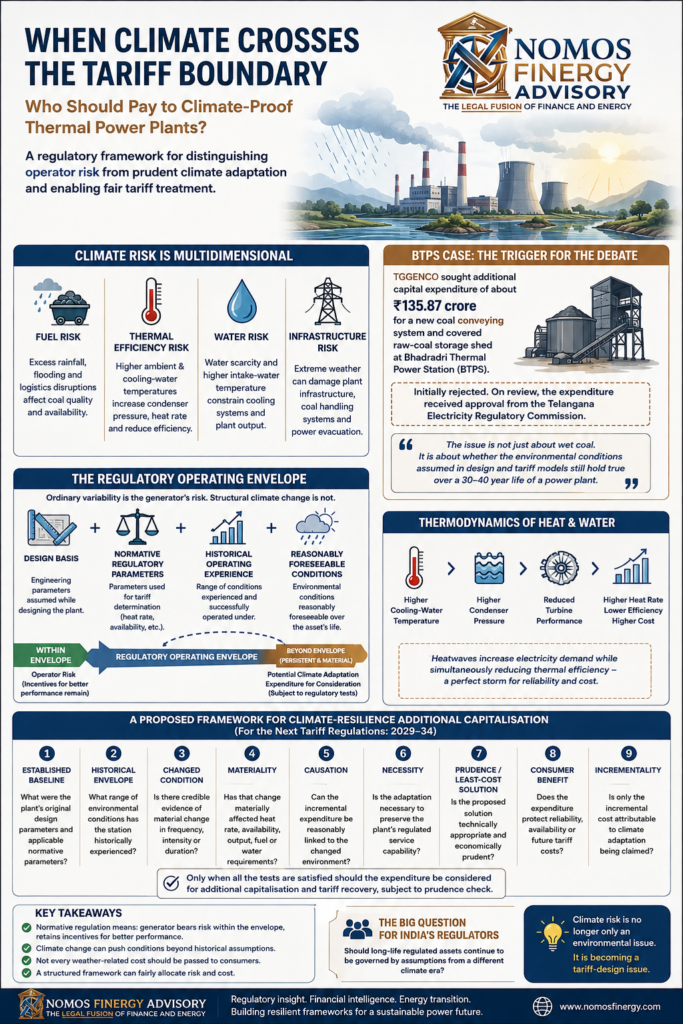
The question emerges from the case of Bhadradri Thermal Power Station (BTPS), where Telangana Power Generation Corporation Limited (TGGENCO) sought additional capital expenditure for a new coal conveying system and a space-frame raw-coal storage shed. The proposed expenditure was about ₹135.87 crore. The matter ultimately received approval from the Telangana Electricity Regulatory Commission after review.
At first sight, this appears to be a story about wet coal.
It may actually be a story about something much larger: whether India’s tariff framework is equipped to deal with climate-related changes in the operating environment of long-life regulated assets.
Where does the risk of wet coal actually arise?
Coal can acquire additional moisture at several points in the fuel chain:
Mine → mine stockyard → transportation → unloading → plant stockyard → coal handling system → boiler.
Therefore, “wet coal” is not necessarily a problem created by the generating station itself.
Heavy rainfall may affect coal at the mine. Transportation may be disrupted or exposed to rain. Coal may become wetter during unloading or storage at the generating station. Excessive rainfall may also cause waterlogging and affect coal-handling infrastructure.
Historically, these have largely been treated as fuel-management and operational risks. Power stations are designed with coal storage, drainage, handling systems, stocking practices and other arrangements intended to deal with reasonably foreseeable variations in coal quality and weather.
But climate variability raises a new question.
What if the conditions for which those systems were designed are themselves changing?
The Regulatory Operating Envelope
A Section 62 tariff is not simply a mechanism for recovering whatever a generator spends.
Cost-plus regulation uses normative parameters—including parameters relating to heat rate, auxiliary consumption, availability and other operating characteristics—to establish a regulatory benchmark. The generator therefore carries ordinary operational risk within the framework, while retaining incentives associated with superior performance.
This creates what I would describe as a Regulatory Operating Envelope.
It is not necessarily a fixed percentage above the design parameter.
Rather, it should be understood through four reference points:
- The engineering design basis of the plant;
- The normative parameters used for tariff determination;
- The station’s demonstrated historical operating experience; and
- Reasonably foreseeable environmental conditions over the asset’s life.
The difficult question begins when the operating environment moves materially beyond this envelope.
Consider temperature
The climate-risk discussion should not stop at rainfall.
For a steam thermal power plant, higher ambient and cooling-water temperatures can have a direct thermodynamic consequence.
The condenser is the heat sink of the Rankine cycle. As cooling-water temperature rises, maintaining the same degree of condensation becomes more difficult. Condenser pressure can rise, reducing the effective turbine expansion and increasing the heat required per unit of electricity generated.
In simplified terms:
Higher cooling-water temperature → higher condenser pressure → poorer turbine performance → higher heat rate → lower efficiency.
At the same time, a heatwave increases electricity demand, particularly for cooling.
This creates a particularly uncomfortable paradox:
The electricity system may need more generation precisely when thermal generation becomes less efficient.
And temperature is only one part of the problem.
Climate risk to a thermal plant is multidimensional
A future regulatory framework may need to consider at least four broad categories of climate exposure:
1. Fuel risk
Excess rainfall, flooding and mine or railway disruption can affect coal quality and coal availability.
2. Thermal efficiency risk
Higher ambient and cooling-water temperatures can affect condenser performance and plant heat rate.
3. Water risk
Drought and declining water availability can constrain cooling systems. Even when water is available, higher intake-water temperature can reduce cooling effectiveness.
4. Infrastructure risk
Floods, cyclones and extreme weather can damage coal-handling systems, railway links, ports, switchyards, transmission infrastructure and other facilities necessary to convert fuel into delivered electricity.
Thus, the real question is no longer merely:
“What happens when coal gets wet?”
It is:
“What happens when the environmental conditions assumed in the design and tariff model no longer adequately represent the conditions under which the plant must operate?”
But should consumers automatically pay?
Certainly not.
This is where regulatory discipline is essential.
A generator should not be permitted to convert every weather-related expenditure into a tariff claim.
Normal operational variability should remain with the generator.
If a plant performs worse than the normative benchmark because of ordinary operational deficiencies, that should not automatically become a consumer liability.
Equally, if the plant performs better than the normative benchmark, the regulatory framework should preserve the incentives associated with superior performance.
The issue is different where a material, persistent and demonstrable change in external environmental conditions requires permanent adaptation of the regulated asset.
That is where the concept of climate-resilience additional capitalisation deserves consideration.
A proposal for the next tariff framework
The Central Electricity Regulatory Commission and State Electricity Regulatory Commissions could consider creating a distinct category of “Climate-Resilience and Environmental Adaptation Expenditure” within the additional-capitalisation mechanism in the next tariff period.
The proposal should not be an automatic pass-through.
A generating company should first establish:
- what the original design and normative parameters were;
- what environmental conditions the station has historically experienced;
- whether the frequency, intensity or duration of the adverse condition has materially changed;
- whether the change has materially affected plant performance;
- whether the expenditure is causally connected to that change;
- whether the expenditure is necessary to maintain regulated service capability;
- whether it is the least-cost and technically prudent solution; and
- what benefit it provides to consumers.
There should also be an incrementality test: only the additional expenditure attributable to climate adaptation should be considered, rather than allowing climate risk to become a route for recovering unrelated renovation or modernisation expenditure.
This is consistent with the basic architecture of tariff regulation. The existing CERC framework already recognises additional capitalisation for specified circumstances, including force majeure and change-in-law events, and the 2024–29 framework provides mechanisms for additional capitalisation subject to the applicable regulatory conditions.
The proposed approach would therefore be an evolution—not a departure—from the existing philosophy.
BTPS provides the trigger for the debate
The BTPS case is particularly instructive because the expenditure involved a new coal conveying system and covered raw-coal storage. The proposal was initially rejected, but the subsequent review resulted in approval of the additional capital expenditure.
The significance of the case, however, should not be reduced to whether wet coal qualifies as force majeure or whether a particular expenditure is admissible.
The larger question is:
Should a 30–40-year regulated power asset continue to be governed by operating assumptions that were established when the environmental conditions were materially different?
If the answer is no, tariff regulation needs a mechanism to distinguish ordinary operating risk from structural environmental adaptation.
From wet coal to climate-proofing the grid
The next generation of tariff regulations could therefore move beyond treating climate risk as an isolated force-majeure event.
A more sophisticated approach would recognise a Regulatory Operating Envelope.
Within that envelope:
Operational risk remains with the generator.
Beyond that envelope, where a material and demonstrable environmental change requires prudent permanent adaptation:
Additional capitalisation may be considered, subject to prudence and consumer-benefit tests.
This approach also preserves the fundamental bargain of normative regulation: the generator retains incentives for better performance, while consumers are protected from ordinary inefficiency.
The emerging challenge is different.
Climate change may alter the physical operating environment of the very assets whose tariffs were designed around historical operating assumptions.
The regulatory question for the next tariff cycle is therefore not simply “Who pays for wet coal?”
It is much bigger:
When climate crosses the regulatory operating envelope, who should pay to keep the power plant capable of serving the consumer?
That is a question India’s electricity regulators may need to answer before the climate answers it for them.
Disclaimer: This article is intended solely for informational, analytical and thought-leadership purposes and does not constitute legal, regulatory, financial, engineering or investment advice. The views and conceptual framework presented, including the proposed “Regulatory Operating Envelope” and the suggested treatment of climate-resilience expenditure under additional capitalisation, represent the author’s analysis and policy perspective and should not be construed as an existing rule, regulation or established position of CERC, any SERC, or any other statutory authority. The discussion of BTPS is based on publicly available regulatory material and is used only to illustrate the issues discussed. The applicability of any tariff treatment or additional capitalisation would depend on the facts of each case, the applicable regulations, prudence review and the determination of the competent regulatory authority. Readers should undertake appropriate professional and regulatory review before relying on any proposition discussed in this article.