
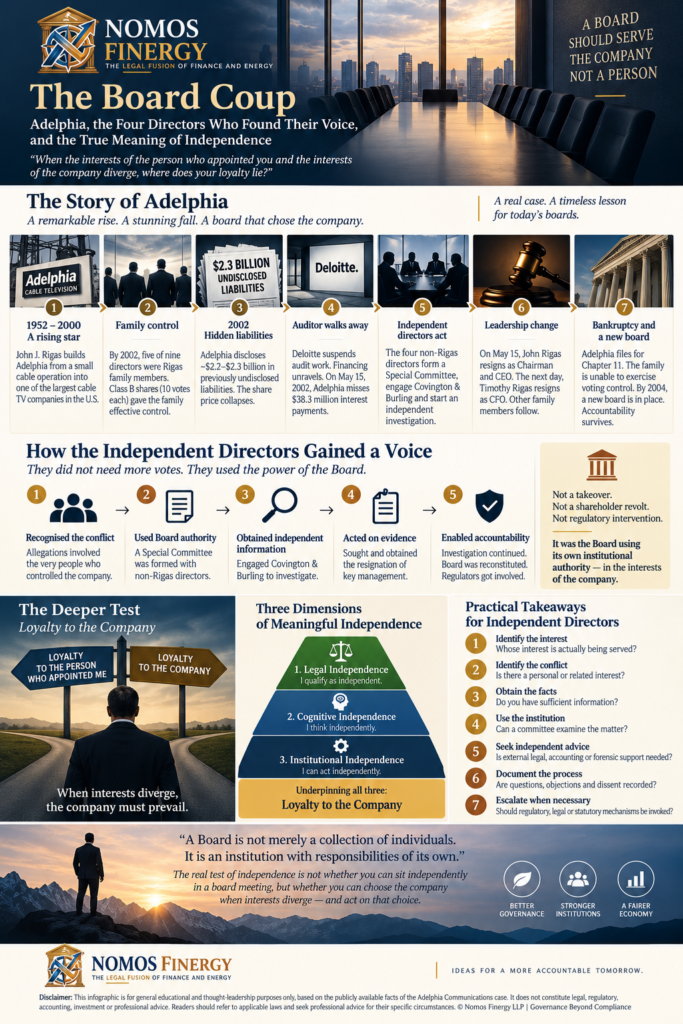
Adelphia, the Four Directors Who Found Their Voice, and the True Meaning of Independence
When the interests of the company and the interests of the person who appointed you begin to diverge, where does your loyalty lie?
The Story
There was a time when Adelphia Communications looked like the classic American success story. Founded by John J. Rigas in Pennsylvania in 1952, the company grew from a small cable operation into one of America’s largest cable television businesses. Rigas was not merely its founder. He was Chairman and CEO. His sons occupied senior positions, including Timothy Rigas as CFO, Chief Accounting Officer and Treasurer. By 2002, five of Adelphia’s nine directors were members of the Rigas family. The family’s Class B shares carried ten votes per share and effectively enabled the family to elect eight of the nine directors. Adelphia was a public company, but much of its ownership, management and Board authority rested within one family.
Then the numbers began to move in a direction investors could not ignore. In March 2002, Adelphia disclosed approximately $2.2–$2.3 billion of previously undisclosed liabilities. The market reacted brutally. The company’s share price fell sharply, eventually collapsing to below a dollar. But the falling share price was only the visible symptom. The real questions were more disturbing: Where had the liabilities come from? Why had they not been properly reflected in the company’s financial reporting? And what was the relationship between Adelphia and businesses controlled by the Rigas family?
Then the auditor stopped. Deloitte & Touche suspended its audit work, while Adelphia indicated that its financial statements might have to be restated. Financing arrangements began to unravel. On May 15, Adelphia failed to make approximately $38.3 million of interest payments, triggering cross-defaults. Inside the Board sat four directors who were not members of the Rigas family: Dennis Coyle, Leslie Gelber, Erland Kailbourne and Pete Metros. They were the minority. The Rigas family had the numbers. Yet these four directors were about to discover that having fewer votes does not necessarily mean having no voice.
The question was almost paradoxical. The allegations increasingly involved transactions between Adelphia and entities associated with the Rigas family. But the Rigas family controlled the Board. Who, then, could investigate the people who controlled the company? In March 2002, the Board had appointed a Special Committee to investigate business relationships between Adelphia and Rigas family affiliates. In May, three of the four non-Rigas directors—Coyle, Gelber and Kailbourne—formed the Special Committee and engaged Covington & Burling to conduct an independent investigation. The question had changed from “Can management explain what happened?” to “Can the company investigate management independently?”
Then came May 15. The Special Committee requested that John Rigas resign as Chairman and CEO. He did. Erland Kailbourne became Chairman and interim CEO. The following day, Timothy Rigas—the company’s CFO, Chief Accounting Officer and Treasurer—resigned pursuant to a request from the Special Committee. Other members of the Rigas family subsequently resigned from their executive and Board positions. The transformation was extraordinary. The independent directors had not bought Adelphia. They had not won a shareholder election. They had not received some extraordinary takeover power from the SEC. They had begun to use the existing authority of the corporate Board to create an independent institutional process.
But there was still one problem. The Rigas family retained enormous voting power through its Class B shares. Why could the family not simply reverse what had happened? The answer lay in the extraordinary circumstances of the collapse. The family agreed to resign, and its ability to exercise its voting power became constrained. Then, on June 25, 2002, Adelphia filed for Chapter 11 bankruptcy protection. Although the family continued to own Class B shares carrying majority voting power, Adelphia later reported that the family was unable to exercise that voting power after resigning and was effectively precluded from exercising it during the Chapter 11 proceedings. Ownership and practical control had separated.
Adelphia could not be saved economically. The company went into bankruptcy. But the governance story continued. The Special Committee’s investigation proceeded, regulators became involved, and the allegations moved from the Boardroom to the courtroom. The SEC alleged that the Rigas family had concealed billions of dollars of liabilities, manipulated financial disclosures and engaged in self-dealing. John Rigas and Timothy Rigas were eventually convicted of securities and bank fraud. After appellate proceedings, they were resentenced to 12 and 17 years in prison respectively.
And eventually, Adelphia rebuilt its Board. By January 2004, the Board consisted of seven directors, none of whom had served during the period when Rigas management operated the company. Governance structures were extensively reformed. The company had not been rescued economically by the Independent Directors. Something else had been achieved: the people who controlled Adelphia had been separated from the institution they controlled, the investigation had been allowed to proceed independently, and accountability had survived the collapse itself.
The Analysis
The real question: How did four minority directors find their voice?
The arithmetic initially appeared hopeless:
Nine directors.
Five Rigas family directors.
Four non-Rigas directors.
And the Rigas family possessed super-voting shares.
So how did four minority directors obtain sufficient authority to investigate management, seek resignations and participate in the reconstruction of the company?
The answer is the most important lesson in the Adelphia case:
They did not acquire power because the share price collapsed. They converted their existing authority as directors into an institutional process through a Board-authorised Special Committee.
The sequence was therefore:
Governance crisis → Special Committee → collective action → independent information → evidence → management accountability → restructuring of control.
The distinction matters because the power of an Independent Director does not necessarily come from shareholding power. It can come from institutional authority.
The Board Coup: What Actually Happened?
The term “Board Coup” is deliberately provocative, but it must be understood correctly.
This was not an unlawful takeover.
It was not a shareholder revolt.
It was not four directors defeating the Rigas family through superior voting power.
It was the opposite.
The Independent Directors recognised that the corporation had its own governance machinery. The Board could create a Special Committee. The committee could investigate matters involving conflicted parties. It could obtain independent professional assistance. And, within its authority, it could act in the interests of the company.
Three of the four non-Rigas directors therefore became the Special Committee.
That changed the nature of their position.
An individual director could say:
“I have concerns.”
A properly constituted committee could say:
“The company will investigate these concerns independently.”
That was the critical transformation—from individual dissent to institutional action.
Why the Conflict Created Their Authority
The Rigas family’s strength was also the source of the problem.
The family controlled:
Ownership → Voting → Board representation → Management
But the allegations concerned transactions and conduct involving the family itself.
That created an obvious governance conflict:
Can the people whose conduct is being investigated control the investigation?
The answer was no.
The Special Committee therefore provided a mechanism for separating the conflicted decision-makers from the institutional investigation.
This is a fundamental principle of good governance.
Independence does not require an Independent Director to be more powerful than the promoter.
It requires the Board to be capable of creating an independent decision-making process when a conflict makes ordinary management control inappropriate.
Information Was Power
There was another critical element: independent information.
The Special Committee engaged Covington & Burling to conduct the investigation. The investigation involved document review and interviews and continued primarily from May 2002 through March 2003. It examined transactions between Adelphia and Rigas family entities and identified allegations involving company resources, the cash management system, financial disclosures, accounting records and undisclosed debt.
This is an often-overlooked dimension of Board independence.
An Independent Director cannot exercise meaningful judgment if management controls all the information on which that judgment depends.
Therefore, in a serious governance dispute:
Independent judgment requires independent information.
And independent information may require:
- direct access to records;
- unrestricted questioning of management;
- independent legal advice;
- forensic or accounting expertise;
- committee-level investigation; and
- proper documentation of the Board process.
Adelphia demonstrates that information independence can turn formal independence into effective oversight.
From Investigation to Accountability
The Special Committee did not stop at identifying concerns.
As evidence accumulated, action followed.
John Rigas resigned as Chairman and CEO.
Timothy Rigas resigned as CFO and other senior positions.
Other Rigas family members subsequently resigned from executive and Board positions.
Erland Kailbourne became Chairman and interim CEO.
The investigation continued even after management changed. The Board was progressively reconstituted, and by January 2004 none of the directors who had served during the Rigas-management period remained on the Board.
This is the point at which independent oversight became institutional accountability.
The Deeper Test of Independence: Loyalty
This is where the Adelphia case becomes especially relevant to India.
Much of the discussion surrounding Independent Directors focuses on whether they are legally independent and capable of exercising objective judgment.
Those are necessary conditions.
But there is a deeper question:
When the interests of the person who supported my appointment and the interests of the company diverge, where does my loyalty lie?
An Independent Director may have been nominated or supported by a:
- promoter;
- controlling shareholder;
- institutional investor;
- founder;
- chairman; or
- other influential stakeholder.
The appointment itself does not destroy independence.
The real test comes when interests separate.
Suppose the person who supported the director’s appointment wants the Board to approve a transaction, but the director believes that transaction is not in the company’s interest.
The director then faces a fundamental choice.
Personal loyalty:
“This person trusted me and supported my appointment.”
Or:
Institutional loyalty:
“My responsibility is to the company and the duties attached to my office.”
When those interests genuinely diverge:
The company must prevail.
This does not mean the Independent Director should automatically oppose the promoter.
If the promoter proposes something that is demonstrably beneficial to the company, the Independent Director should support it.
Independence is not opposition.
It is the freedom to decide for the company, regardless of who proposed the matter.
Three Dimensions of Meaningful Independence
The entire issue can therefore be reduced to three levels.
1. Legal Independence
“I qualify as independent.”
The director satisfies the applicable legal and regulatory requirements.
This establishes status.
2. Cognitive Independence
“I think independently.”
The director questions assumptions, financial judgments, related-party transactions, risk assessments and management explanations.
This establishes independent judgment.
3. Institutional Independence
“I can act independently.”
The director is prepared to obtain information, record dissent, seek independent advice, use Board committees, support an independent investigation and escalate serious concerns where appropriate.
This establishes effective governance.
But beneath all three is the fundamental test:
Loyalty to the Company
When the interests of the appointing person and the interests of the company remain aligned, there is no dilemma.
When they diverge, the Independent Director must ask:
“Whose interest governs my decision?”
The answer should be:
The company’s.
What Should an Indian Independent Director Do?
The Adelphia lesson can be translated into a practical framework.
1. Identify the interest
Whose interest is actually being served?
2. Identify the conflict
Does the promoter, management or another director have a personal or related interest?
3. Obtain the facts
Do I have sufficient information to make an independent judgment?
4. Use the institution
Can the Audit Committee, Special Committee or another appropriate Board mechanism examine the matter?
5. Obtain independent advice
Is independent legal, accounting, financial or forensic expertise required?
6. Document the process
Are questions, objections, explanations and dissent properly recorded?
7. Escalate when necessary
If the matter becomes sufficiently serious, should appropriate corporate, regulatory, legal or statutory mechanisms be invoked?
The objective is not to fight the promoter.
It is to ensure that the company remains capable of governing itself when interests diverge.
The Adelphia Formula
The Adelphia experience can therefore be expressed simply:
Independent Judgment + Independent Information + Collective Action + Institutional Authority = Effective Board Oversight
But there is one principle underneath the entire formula:
When personal loyalty and institutional responsibility conflict, loyalty to the company must prevail.
That is the true test of independence.
The Ultimate Lesson
The Rigas family began the Adelphia story with almost every conventional source of power:
Ownership.
Voting control.
Board control.
Management control.
Information control.
The Independent Directors had very little comparable power.
Yet they created something more important:
institutional legitimacy.
They used a Board-authorised Special Committee. They obtained independent professional assistance. They created an investigative process that management could not control. They sought management changes when the evidence warranted them. And the Board was subsequently rebuilt.
They did not win because four directors had more votes than five family directors.
They won institutional influence because they understood something fundamental:
A Board is not merely a collection of individuals. It is an institution with responsibilities of its own.
That is why Adelphia deserves to be studied by Independent Directors.
The lesson is not that an Independent Director must confront a promoter.
The lesson is that when a serious conflict arises, an Independent Director must know how to convert individual judgment into legitimate institutional action.
And before all of that comes the most important question:
When the interests of the person who appointed me and the interests of the company diverge, where does my duty lie?
Nomosfinergy Perspective
The phrase “Independent Director” can sometimes create the impression that independence is simply a legal status.
It is much more than that.
A meaningful Independent Director should be able to move through three stages:
Legal Independence
I qualify as independent.
↓
Cognitive Independence
I think independently.
↓
Institutional Independence
I can turn my judgment into a legitimate Board process.
But all three ultimately serve one principle:
Loyalty to the Company
An Independent Director may be nominated by a promoter.
He may be recommended by a controlling shareholder.
He may have a professional or personal relationship with the person who supported his appointment.
None of these facts, by themselves, necessarily determine whether he is independent.
The decisive moment comes when interests genuinely diverge.
When the person who supported your appointment wants one thing—
and the interests of the company require another—
whose side do you take?
The answer should not depend on gratitude, fear, personal association or the identity of the person proposing the matter.
It should depend on what is in the interests of the company, based on independent judgment and the facts available to the Board.
That is where corporate governance moves beyond compliance.
The true test of an Independent Director is therefore not whether he can sit independently in a Board meeting.
It is whether, when powerful individual interests and institutional interests genuinely diverge,
he has the independence to choose the institution—and the institutional discipline to act on that choice.
Nomos Finergy — Governance Beyond Compliance
Disclaimer
This article has been prepared by Nomos Finergy LLP for general corporate-governance thought leadership and educational purposes. The Adelphia Communications case is presented as an international case study to illustrate principles relating to Board independence, conflicts of interest, corporate governance and the role of Independent Directors. While reasonable care has been taken in presenting the factual narrative, the article is not intended to constitute legal, regulatory, accounting, investment or professional advice, nor should it be relied upon as a substitute for advice from appropriately qualified professionals.
The discussion of Indian Independent Directors is conceptual and should be read together with the Companies Act, 2013, applicable SEBI regulations, stock-exchange requirements, judicial decisions and other laws and regulations applicable to the particular company and circumstances. The views expressed are those of Nomos Finergy LLP for discussion and thought-leadership purposes and do not represent the views of any regulator, court, company or other institution referred to in this article.
Readers should independently verify the applicable legal and regulatory position before taking any corporate, Board or professional action.
© Nomos Finergy LLP | Governance Beyond Compliance