
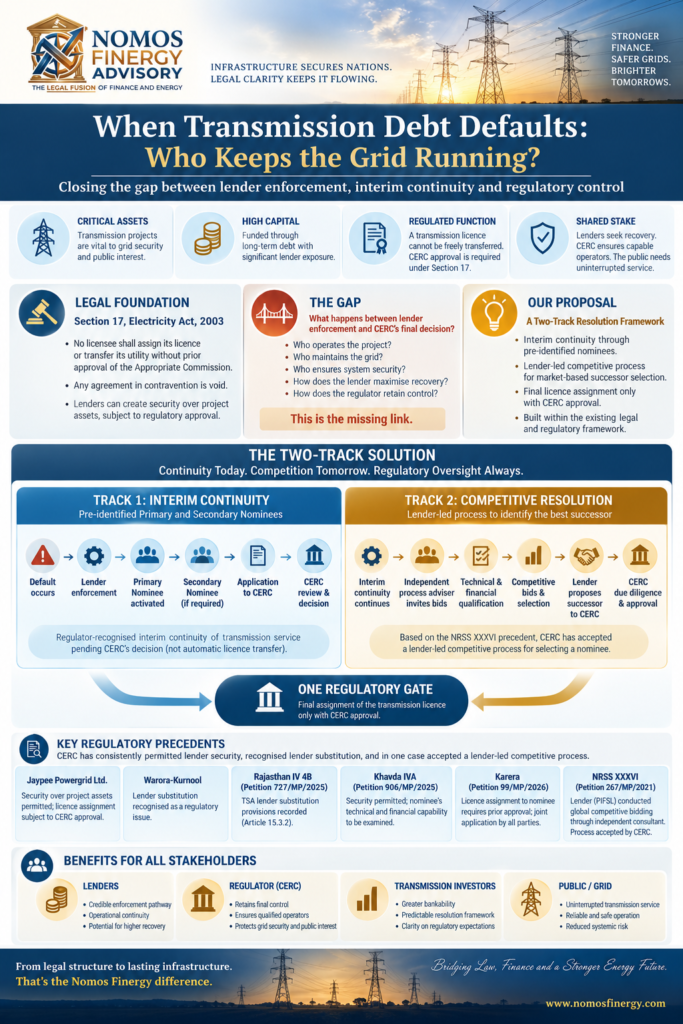
When Transmission Debt Defaults: Who Keeps the Grid Running?
Closing the gap between lender enforcement, interim continuity and regulatory control
A Nomos Finergy Advisory proposal for a more bankable and operationally resilient transmission framework
A transmission project is unlike an ordinary infrastructure asset.
A lender can enforce security over land, equipment, receivables, shares and other project assets. But a transmission licence is a regulatory authorisation. It carries with it the right—and the obligation—to operate a part of the electricity network. That makes the enforcement of security over a transmission project fundamentally different from the enforcement of security over an ordinary industrial asset.
The difficult question is therefore not simply:
Can a lender enforce its security?
The more important question is:
What happens to the transmission function between the moment of lender enforcement and the moment the regulator approves the successor?
That is the regulatory gap this proposal seeks to address.
1. The legal starting point: Section 17 draws the boundary
Section 17(3) of the Electricity Act, 2003 provides:
“No licensee shall at any time assign his licence or transfer his utility…without the prior approval of the Appropriate Commission.”
Section 17(4) goes further: an agreement relating to such a transaction without prior approval is void.
The principle is therefore clear.
A transmission licence cannot be treated as ordinary freely transferable collateral.
But this does not mean that lenders are without protection.
CERC has, over many years, permitted transmission licensees to create security interests over project assets in favour of lenders and security trustees, while keeping the transfer of the licence itself subject to regulatory approval. For example, in Jaypee Powergrid Ltd., CERC gave in-principle approval for security over project assets while making clear that the licence could not be assigned to the lender without prior Commission approval.
This distinction is fundamental:
Financial security can be created. Regulatory control cannot simply be contracted away.
2. The framework already contains the seeds of lender substitution
The important point is that the existing regulatory architecture is not silent about lender intervention following default.
Transmission Service Agreements commonly contain a lender-substitution mechanism.
In the Rajasthan IV 4B Power Transmission matter, CERC reproduced Article 15.3.2 of the TSA, under which, following debt default, the Commission may, on an application from lenders, assign the transmission licence to the lenders’ nominee, subject to qualification requirements.
The present CERC framework is even more explicit.
Regulation 8 of the CERC (Procedure, Terms and Conditions for Grant of Transmission Licence and other related matters) Regulations, 2024 provides:
“In case of default by the licensee in debt repayment, the Commission may, on an application made by the lenders, assign the licence to a nominee of the lenders.”
This is an important statutory bridge between project finance and electricity regulation.
The lender does not receive an automatic licence.
Instead, the lender receives a regulatory pathway to propose a successor.
3. CERC has also recognised the lender’s economic security
Recent CERC orders show that security over transmission project assets is not merely theoretical.
In Khavda IVA Power Transmission Ltd., Petition No. 906/MP/2025, CERC granted in-principle approval for security over the project’s movable and immovable assets by mortgage or other security documents. At the same time, it expressly preserved the regulatory gate for licence assignment.
The Commission stated that before approving assignment to a lender’s nominee, it would evaluate the nominee’s:
- experience in development;
- design;
- construction;
- operation and maintenance of transmission lines; and
- ability to execute the project and undertake transmission of electricity.
The same approach was reiterated in Karera Power Transmission Ltd., Petition No. 99/MP/2026.
CERC approved security arrangements while stating that the licence could not be assigned to the Security Trustee or lender’s nominee without prior approval. It also required the licensee, lender, security trustee and nominee to approach the Commission jointly.
This establishes an important principle:
The lender can control the economic recovery process; CERC retains control over who becomes the regulated transmission licensee.
4. But a critical gap remains
Consider a simple sequence:
Default → lender enforcement → successor identified → application to CERC → regulatory due diligence → approval → licence assignment
What happens in between?
A transmission line cannot simply become operationally ownerless.
The grid does not stop functioning because a project company has defaulted on its debt.
The existing framework deals reasonably well with the two ends of the problem:
Lender protection at one end.
Regulatory approval at the other.
What needs greater clarity is the bridge between the two.
That is where Nomos Finergy proposes a two-track framework.
5. Proposed Framework: Two Tracks, One Regulatory Gate
Track 1 — Pre-identified Interim Continuity
A lender and TSP identify, at financial close:
- Primary Nominee
- Secondary Nominee
These entities would be pre-qualified against technical, financial and operational criteria.
The purpose is not to give either entity an automatic transmission licence.
Instead, the TSA and financing documents would establish a pre-agreed continuity mechanism.
On default:
1. Financial default occurs
↓
2. Lender exercises contractual enforcement rights
↓
3. Primary Nominee is activated
↓
4. If unavailable/disqualified, Secondary Nominee is activated
↓
5. Immediate application is made to CERC
↓
6. CERC examines the nominee
↓
7. CERC approves or rejects licence assignment
The crucial distinction is this:
Interim operation ≠ automatic licence transfer
The interim arrangement should be legally structured as a regulator-recognised continuation of the transmission service function pending CERC’s decision, rather than as an automatic assignment of the licence.
That distinction protects Section 17 while addressing the practical problem of operational continuity.
6. Why this is not a violation of Section 17
The proposal does not seek to bypass Section 17.
It seeks to make Section 17 workable during a distress event.
The licence would not be transferred merely because a lender has enforced its security.
Instead:
- the lender activates the agreed continuity mechanism;
- the nominee operates within the framework permitted by the regulator;
- the lender immediately approaches CERC;
- CERC conducts due diligence;
- final assignment remains subject to CERC’s approval.
In other words:
Do not transfer the licence before regulatory approval. But do not allow the transmission function to become operationally homeless while regulatory approval is being considered.
This is particularly important for strategically important transmission corridors where interruption could have consequences extending well beyond the project company and its lenders.
7. Track 2: What if the lender wants to find a better successor?
This is where the proposal becomes more interesting.
Instead of restricting the lender to a pre-identified nominee, the framework should permit a Lender-led Competitive Resolution Process following default.
The sequence could be:
Default
↓
Lender enforcement
↓
Interim continuity under Primary/Secondary Nominee
↓
Independent process adviser appointed
↓
Competitive invitation for qualified bidders
↓
Technical & financial qualification
↓
Commercial bidding / price discovery
↓
Preferred bidder selected
↓
Lender nominates preferred bidder
↓
CERC due diligence
↓
Licence/project transfer, if approved
This would create a market-based mechanism for discovering the most commercially suitable successor while preserving the regulator’s final authority.
And, importantly, there is already a remarkably close regulatory precedent.
8. NRSS XXXVI: the evidence for Track 2
The most compelling precedent is NRSS XXXVI Transmission Ltd., Petition No. 267/MP/2021.
This is not merely a theoretical possibility.
In that case, lender PTC India Financial Services Ltd. (PIFSL) appointed an independent consultant, ABPS Infra, to conduct a global competitive bidding process for selecting the lender’s nominee.
CERC recorded that the consultant issued an RFP for selection of a bidder to act as the lender’s nominee to acquire the shareholding of NRSS XXXVI and execute and operate the project under the TSA.
The RFP contained technical requirements, including experience in:
- project development;
- design;
- construction; and
- O&M of EHV transmission lines.
It also prescribed a financial qualification based on net worth. Three bidders submitted bids, including Adani Transmission, a consortium of IndiGrid and Techno Electric & Engineering, and Resurgent Power Ventures. After technical and financial evaluation, Resurgent Power Ventures emerged as the successful bidder.
This is highly significant.
CERC specifically recorded:
“the lender, PIFSL had appointed an Independent Consultant, ABPS Infra” for a global competitive bidding process to finalise the nominee.
The case therefore demonstrates that a lender-led competitive process for identifying a proposed successor is not an entirely novel concept in the Indian transmission sector.
But there is an essential legal distinction.
This was not Government TBCB.
It was not the lender assuming the role of the Government’s Bid Process Coordinator.
It was a lender-led competitive nominee-selection process following financial distress, ultimately subject to the regulatory framework governing licence assignment.
That distinction should be preserved in any future framework.
9. Why Track 2 should not be called “TBCB”
Government TBCB has a different purpose and architecture.
The Ministry of Power’s revised guidelines and Standard Bidding Documents govern procurement of inter-State transmission services through the tariff-based competitive bidding process. They provide for a formal bidding architecture involving the designated Bid Process Coordinator (BPC).
That process is essentially:
Government / designated BPC
→ RFQ/RFP
→ selected bidder
→ acquisition/development of transmission SPV
→ transmission licence
→ TSA
A lender-led resolution process is different.
Its purpose is not to procure a new transmission project on behalf of the procuring authority.
Its purpose is:
to identify a commercially and technically qualified successor for an already-existing or distressed transmission project.
Therefore, the proposed process should be called:
Lender-led Competitive Resolution Process
rather than TBCB.
The distinction is more than semantic. It avoids suggesting that a private lender is exercising powers that belong to the Government or the statutory bidding authority.
10. What should happen after the successful bid?
The successful bidder should not automatically become the transmission licensee.
The lender’s process should produce a:
Preferred Successor / Proposed Nominee
The successful bidder would then be submitted to CERC.
CERC should examine:
| Regulatory test | Key question |
|---|---|
| Technical capability | Can the bidder develop/design/operate/maintain the system? |
| Financial capability | Can it support the project and meet financial obligations? |
| Regulatory compliance | Does it satisfy applicable licence requirements? |
| Grid capability | Can it maintain reliable system operation? |
| Operational continuity | Can it assume responsibility without disruption? |
| Commercial credibility | Is the proposed transaction credible and properly structured? |
| System criticality | Does the project have strategic importance requiring enhanced safeguards? |
| Process integrity | Was the lender-led process transparent and competitive? |
The principle should be:
Qualification first. Price second.
The highest financial bid should not automatically determine who receives regulatory approval.
A bidder may offer the highest price but lack the technical or operational capability required of a transmission licensee.
The market process should therefore inform the regulatory decision—not replace it.
11. The proposed dual-track model
| Stage | Track 1: Pre-identified successor | Track 2: Competitive resolution |
|---|---|---|
| Financial close | Primary + Secondary Nominee identified | Competitive mechanism documented |
| Default | Lender enforcement | Lender enforcement |
| Immediate continuity | Primary Nominee | Primary/Secondary Nominee |
| CERC application | Immediate | Immediate/interim |
| Successor selection | Pre-identified | Competitive process |
| Process adviser | Optional | Independent adviser |
| Price discovery | Not essential | Yes |
| Technical qualification | Pre-assessed + CERC review | Mandatory |
| Financial qualification | Pre-assessed + CERC review | Mandatory |
| Final nominee | Primary/Secondary | Preferred bidder |
| Regulatory gate | CERC | CERC |
| Licence assignment | Only after approval | Only after approval |
| Objective | Continuity | Continuity + value discovery |
The two tracks are therefore complementary, not competing.
Track 1 solves the time problem.
Track 2 solves the successor-selection and value-recovery problem.
12. The TSA should become the first line of defence
The TSA and financing documentation should be drafted with the distress scenario in mind—not merely the financial close.
A future-generation TSA could expressly address:
A. Security
- project assets;
- receivables;
- escrow/TRA;
- insurance proceeds;
- project contracts;
- other permissible security interests.
B. Default
Define the circumstances triggering lender intervention.
C. Two-stage nominee mechanism
Identify:
Primary Nominee → Secondary Nominee
with defined eligibility criteria.
D. Interim continuity
Provide a contractual framework under which the nominated entity can maintain operational continuity subject to the regulatory framework and CERC directions.
E. Competitive resolution
Permit the lender, after default, to appoint an independent adviser and conduct a transparent competitive process for identifying a successor.
F. Regulatory application
Require prompt joint submission to CERC.
G. Information and cooperation
The TSP should be required to provide lenders and prospective nominees with relevant project, technical, financial and contractual information.
H. O&M continuity
Existing O&M contractors and technical personnel should, where appropriate, continue during transition rather than being unnecessarily disrupted.
13. The financing documents should mirror the regulatory architecture
The Common Loan Agreement, Security Trustee Agreement and related documents should not simply say:
“The lender may enforce the security.”
They should answer the next question:
“What exactly happens on the day after enforcement?”
The documentation should therefore contemplate:
Default → enforcement → continuity → nominee → competitive resolution, where required → CERC application → regulatory approval → final transfer.
This is where project finance documentation can move from being merely security-oriented to being resolution-oriented.
14. A regulatory framework for distressed transmission assets
The proposal can ultimately be reduced to one simple institutional principle:
Three gates, not one
Gate 1 — Financial
Can the lender enforce its security and protect its economic interest?
↓
Gate 2 — Operational
Can the transmission function continue without disruption?
↓
Gate 3 — Regulatory
Is the proposed successor technically, financially and legally fit to hold the licence?
Only when the third gate is passed should the final licence assignment occur.
This preserves the statutory role of CERC while making lender enforcement commercially meaningful.
15. The larger policy question
India is investing heavily in transmission infrastructure.
Transmission projects are capital-intensive, long-duration assets with regulated revenues and significant debt financing.
A financing structure becomes more bankable when lenders know that, in the event of default, there is a credible and predictable resolution pathway.
At the same time, the electricity regulator must ensure that the grid is not handed to an entity merely because it purchased the distressed asset.
The solution is therefore neither:
“Lenders cannot interfere.”
nor:
“Lenders can freely take over the licence.”
The more durable solution is:
Financial enforcement + operational continuity + regulatory approval.
CERC’s recent orders already point in this direction. In Karera and Khavda IVA, the Commission has expressly separated security over project assets from the assignment of the licence and retained the right to assess the nominee’s technical and operational capability.
NRSS XXXVI goes one step further by showing that a lender-led competitive process for identifying a nominee can operate within this architecture.
The opportunity now is to convert these individual regulatory practices into a clear, standardised framework.
16. The Nomos Finergy proposal
Nomos Finergy proposes that the transmission-sector regulatory framework formally recognise a:
“Distressed Transmission Project Resolution Framework”
built around two parallel mechanisms:
Track 1 — Interim Continuity Mechanism
Pre-identified Primary and Secondary Nominees, capable of maintaining the transmission function pending CERC’s decision.
Track 2 — Lender-led Competitive Resolution Mechanism
A transparent, independently administered competitive process through which lenders can identify a technically and financially qualified successor, whose appointment remains subject to CERC’s regulatory approval.
The framework should be embedded through appropriate provisions in:
- Transmission Service Agreements;
- financing documents;
- security trustee arrangements;
- transmission licence conditions; and
- CERC regulations/guidelines.
This would make the resolution process more predictable without diluting the Commission’s statutory control over the transmission licence.
Conclusion: The licence should never become homeless
A transmission project can default financially.
A lender can enforce its security.
A shareholder can lose control.
But the transmission function cannot be allowed to fall into a regulatory vacuum.
The existing law already provides the essential architecture: Section 17 protects regulatory control; CERC permits security over project assets; TSA provisions recognise lender substitution; Regulation 8 provides a route for assignment to a lender’s nominee; and recent CERC orders demonstrate increasing clarity on the qualification and due-diligence requirements for such nominees.
NRSS XXXVI provides particularly valuable evidence that a lender can use an independent adviser and a competitive process to identify a proposed successor.
What remains is to connect these pieces.
Do not transfer the licence before regulatory approval.
But do not allow the transmission function to become operationally homeless while regulatory approval is being considered.
That is the gap.
And closing that gap can make India’s transmission sector simultaneously more bankable, more resilient and more regulatorily disciplined.
Legal / regulatory note
This article distinguishes between the existing statutory and regulatory framework, CERC’s orders and the policy proposal advanced by Nomos Finergy. The proposed interim-continuity mechanism and lender-led competitive resolution mechanism are policy proposals, not statements that CERC has already formally adopted such a framework. In particular, the lender-led competitive process should not be confused with Government-led Tariff Based Competitive Bidding under Section 63. The NRSS XXXVI proceedings provide evidence of a lender-led competitive nominee-selection process, while final assignment of a transmission licence remains subject to the Appropriate Commission’s approval.
Disclaimer
This article is intended solely for general informational, analytical and thought-leadership purposes. It does not constitute legal, regulatory, financial, investment, engineering or professional advice. References to the Electricity Act, CERC regulations, Transmission Service Agreements, financing documents and CERC proceedings are based on publicly available regulatory material. The proposed “Interim Continuity Licence/Permission”, two-nominee framework, Transmission Credit-Event Due Diligence and related mechanisms are conceptual policy proposals and are not represented as existing CERC rules or established legal rights.Actual rights and obligations will depend on the Electricity Act, applicable CERC regulations, the relevant TSA, transmission licence, financing and security documents, and the facts of each project.
Nomos Finergy Advisory
The Legal Fusion of Finance and Energy