
“Our PPA is yet to be approved. Can we still recover the value of the electricity supplied?”
This is perhaps one of the most frequently asked questions by renewable energy developers today.
The answer, however, is not found entirely in the Electricity Act, 2003 or in the applicable tariff regulations. Surprisingly, the answer lies in a provision enacted more than 150 years ago—Section 70 of the Indian Contract Act, 1872.
Although Section 70 was never drafted with renewable energy projects in mind, recent judicial decisions suggest that it could play an increasingly important role in resolving disputes involving pre-COD power injection.
Before discussing the recent APTEL judgments, let us first understand what Section 70 actually says.
Section 70 – The Law Against Unjust Enrichment
Section 70 of the Indian Contract Act reads:
“Where a person lawfully does anything for another person, or delivers anything to him, not intending to do so gratuitously, and such other person enjoys the benefit thereof, the latter is bound to make compensation to the former in respect of, or to restore, the thing so done or delivered.”
At first reading, the provision appears deceptively simple.
However, every word in the section has legal significance.
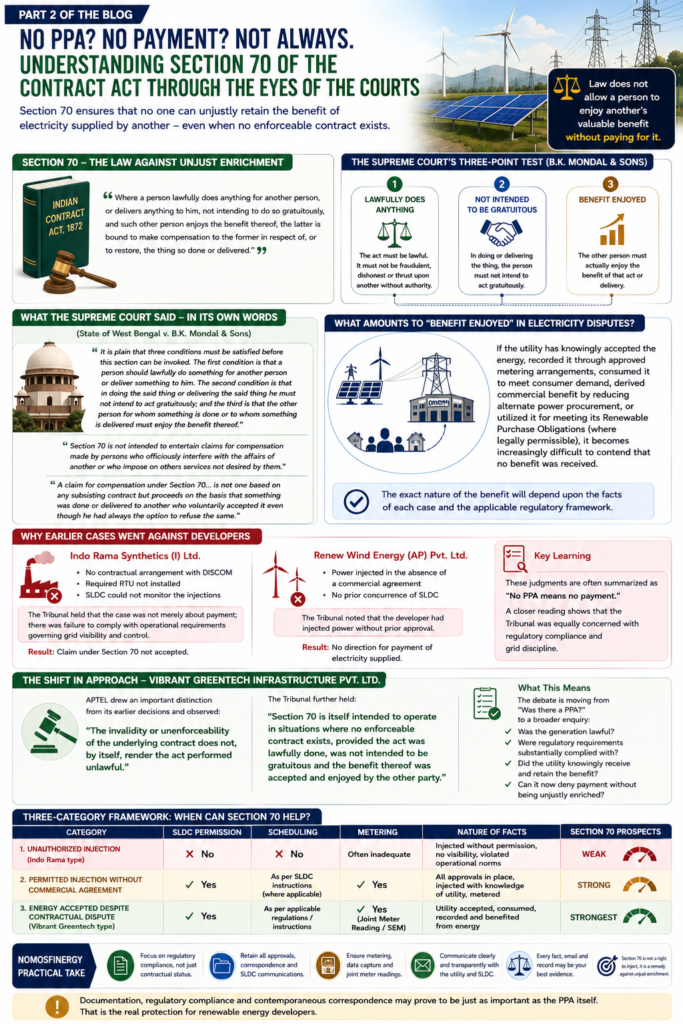
More importantly, the Supreme Court has clarified that three conditions must exist before Section 70 can be invoked.
The Supreme Court’s Three-Point Test
The landmark judgment in State of West Bengal v. B.K. Mondal & Sons continues to be the foundation of every claim under Section 70.
The Supreme Court observed:
“It is plain that three conditions must be satisfied before this section can be invoked. The first condition is that a person should lawfully do something for another person or deliver something to him. The second condition is that in doing the said thing or delivering the said thing he must not intend to act gratuitously; and the third is that the other person for whom something is done or to whom something is delivered must enjoy the benefit thereof.”
Even today, these three ingredients determine whether a developer can successfully invoke Section 70.
Let’s examine each one from the perspective of a renewable energy project.
Condition One: The Act Must Be Lawful
This is perhaps the most misunderstood requirement.
Many people assume that absence of a valid PPA automatically makes the supply unlawful.
That is not what Section 70 says.
The Supreme Court explained that the expression “lawfully” is intended to exclude acts that are fraudulent, dishonest or thrust upon another person without authority.
In B.K. Mondal, the Court further observed:
“Section 70 is not intended to entertain claims for compensation made by persons who officiously interfere with the affairs of another or who impose on others services not desired by them.”
This observation is extremely important for electricity disputes.
If a developer secretly injects power into the grid without statutory approvals, contrary to SLDC directions, or in violation of the Grid Code, proving that the supply was “lawful” becomes difficult.
On the other hand, where statutory approvals exist, synchronization has been permitted, evacuation infrastructure is available, and the utility knowingly receives the electricity, the question becomes much more nuanced.
The debate is no longer about the existence of a contract.
It becomes a question of whether the act of supplying electricity itself was lawful.
NomosFinergy Practical Take
A missing PPA and an unlawful injection are not always the same thing.
The legal enquiry should begin with regulatory compliance—not merely contractual status.
Condition Two: The Supply Must Not Be Gratuitous
Fortunately, this requirement is usually straightforward in the electricity sector.
No developer invests hundreds of crores in a renewable energy project intending to donate electricity to a distribution licensee.
Every megawatt generated is expected to generate revenue.
The commercial intent is obvious.
In most renewable projects, therefore, establishing this requirement is rarely difficult.
Condition Three: The Beneficiary Must Have Enjoyed the Benefit
This is where Section 70 becomes particularly relevant to electricity.
Unlike machinery or construction materials, electricity cannot be returned once it enters the grid.
However, merely because electricity has been injected does not automatically mean that the beneficiary has “enjoyed” its benefit.
The real enquiry is factual.
If the utility has knowingly accepted the energy, recorded it through approved metering arrangements, consumed it to meet consumer demand, derived commercial benefit by reducing alternate power procurement, or utilized it for meeting its Renewable Purchase Obligations (where legally permissible), it becomes increasingly difficult to contend that no benefit was received. The exact nature of the benefit will depend upon the facts of each case and the applicable regulatory framework.
This distinction is important because Section 70 is founded upon the equitable doctrine of unjust enrichment.
The law does not permit a person to knowingly retain another’s valuable commercial benefit without compensating the person who supplied it.
The Principle Behind Section 70 Is Not Contract—It Is Equity
One of the most significant observations in B.K. Mondal is often overlooked.
The Supreme Court explained:
“A claim for compensation under Section 70… is not one based on any subsisting contract but proceeds on the basis that something was done or delivered to another who voluntarily accepted it even though he had always the option to refuse the same.”
The Court also described Section 70 as a provision intended to prevent unjust enrichment where no enforceable contract exists.
This single principle has now become increasingly relevant in renewable energy disputes.
Why Earlier Renewable Energy Cases Were Decided Against Developers
At this stage, many readers may ask:
“If Section 70 has existed for over a century, why did renewable energy developers lose so many earlier cases?”
The answer lies in the facts.
Indo Rama Synthetics
In Indo Rama Synthetics, the Tribunal found that there was no contractual arrangement with the DISCOM and that the required Remote Terminal Unit (RTU) had not been installed, leaving the SLDC unaware of the injections. The dispute was therefore not merely about payment; it also involved failure to comply with operational requirements governing grid visibility and control. As a result, the Tribunal did not accept the claim for compensation under Section 70.
Renew Wind Energy
Likewise, in Renew Wind Energy, the Tribunal noted that the developer had injected power in the absence of a commercial agreement and without prior concurrence of the SLDC. Those facts were critical to the outcome, and the Tribunal declined to direct payment for the electricity supplied.
These judgments are often summarized as saying:
“No PPA means no payment.”
That, however, is an oversimplification.
A closer reading shows that the Tribunal was equally concerned with regulatory compliance and grid discipline.
The projects had difficulty demonstrating that the supply itself satisfied the first ingredient of Section 70—that it had been lawfully undertaken.
The Industry Changed Before the Law Did
Renewable energy projects today look very different from those commissioned fifteen years ago.
Many projects now receive:
- statutory approvals,
- synchronization permission,
- approved metering,
- completed evacuation infrastructure,
long before commercial approvals are finalized.
The electricity sector therefore started witnessing a new class of disputes.
These were not cases of clandestine power injection.
They involved projects where utilities were fully aware that electricity was being generated and exported.
The legal question therefore evolved.
Instead of asking,
“Was there a valid contract?”
the courts increasingly began asking,
“Was the supply lawful? Was it accepted? Did the beneficiary enjoy its commercial value?”
That shift became clearly visible in the recent Vibrant Greentech judgment.
There, APTEL drew an important distinction from its earlier decisions and observed:
“The invalidity or unenforceability of the underlying contract does not, by itself, render the act performed unlawful.”
The Tribunal went on to reaffirm that Section 70 is specifically designed to operate where no enforceable contract exists, provided the act was lawful, non-gratuitous and its benefit was accepted and enjoyed.
That observation may well become one of the most significant developments in the jurisprudence relating to pre-COD power injection.
NomosFinergy Practical Take
The debate is gradually moving away from a binary question of “Was there a PPA?” towards a more nuanced enquiry:
- Was the generation lawful?
- Were regulatory requirements substantially complied with?
- Did the utility knowingly receive and retain the benefit?
- Can it now deny payment without being unjustly enriched?
The answers will always depend on the facts of each case. But one thing is becoming increasingly clear: documentation, regulatory compliance and contemporaneous correspondence may prove to be just as important as the PPA itself.