
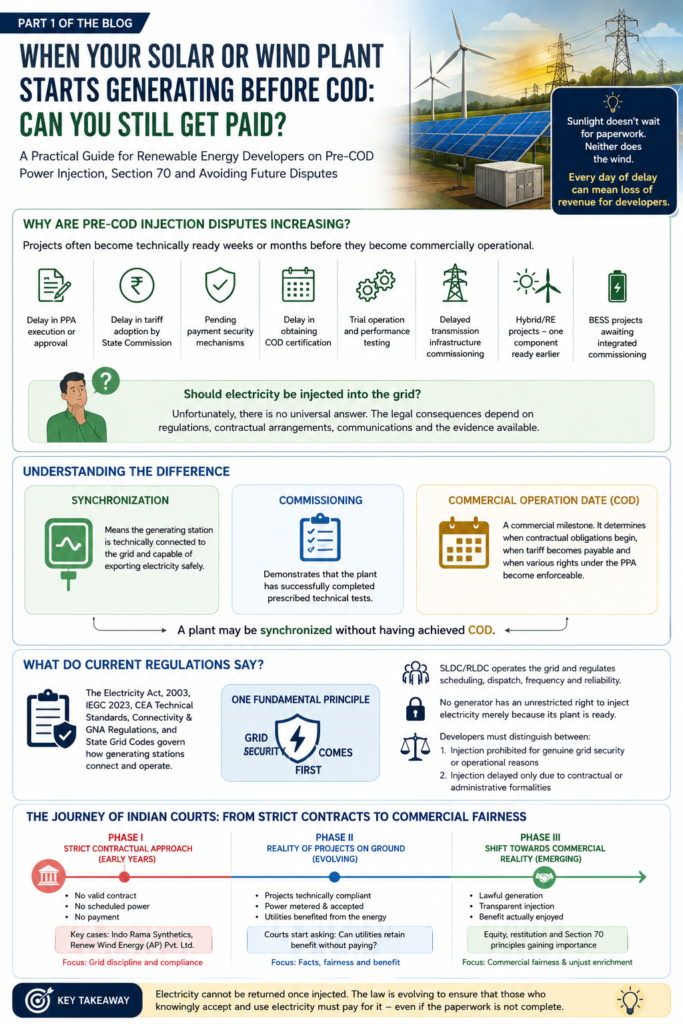
A Practical Guide for Renewable Energy Developers on Pre-COD Power Injection, Section 70 of the Contract Act, and Avoiding Future Disputes-Part 1
By NomosFinergy LLP
“Your plant is ready. The turbines are spinning, the solar modules are producing electricity, and the transmission line is energized. But your Commercial Operation Date (COD) is still pending because a regulatory approval, PPA approval, or utility clearance is stuck somewhere in the system. Do you inject power into the grid or wait?”
It sounds like a hypothetical situation. In reality, it is becoming one of the most common commercial dilemmas faced by renewable energy developers in India.
A decade ago, projects generally achieved synchronization, commissioning, and COD within a relatively short period. Today, things are very different. Projects often become technically ready weeks—or even months—before they become commercially operational. The reasons are many: delays in PPA approval, pending tariff adoption, transmission clearances, scheduling permissions, payment security mechanisms, or simply administrative bottlenecks.
The unfortunate part is that sunlight doesn’t wait for paperwork. Neither does the wind.
Once a project is capable of generating electricity, every day of delay means potential loss of revenue. Developers naturally want to inject power into the grid. Utilities, on the other hand, become cautious because commercial arrangements are still incomplete. Somewhere in between lies a legal grey area that has generated numerous disputes before Electricity Regulatory Commissions and the Appellate Tribunal for Electricity (APTEL).
Fortunately, the law on this subject is evolving. Recent judicial decisions indicate that courts are moving beyond the simplistic question of “Was there a valid contract?” to a far more practical question:
“If someone knowingly accepted and benefited from electricity generated by another person, should they be allowed to retain that benefit without paying for it?”
This article explores how Indian law is answering that question and, more importantly, what renewable energy developers should do to protect themselves.
Why Are Pre-COD Injection Disputes Increasing?
The renewable energy sector has matured significantly over the past decade. Utility-scale projects today involve multiple agencies, approvals and stakeholders.
A developer may receive land approvals, connectivity approval, transmission evacuation facilities and synchronization permission well before the PPA receives regulatory approval. In some cases, the generating station is physically complete while the buyer is still finalizing contractual documentation.
Several situations commonly lead to pre-COD generation:
- Delay in execution or approval of the Power Purchase Agreement (PPA)
- Delay in tariff adoption by the State Commission
- Pending payment security arrangements
- Delay in obtaining Commercial Operation Date certification
- Trial operation and performance testing
- Delayed commissioning of associated transmission infrastructure
- Hybrid renewable projects where one component is ready before another
- Battery Energy Storage Systems (BESS) awaiting integrated commissioning
- Open access approvals pending despite project readiness
In all these situations, the developer faces the same question:
Should electricity be injected into the grid?
Unfortunately, there is no universal answer. The legal consequences depend upon the applicable regulations, contractual arrangements, communications exchanged between the parties and, increasingly, the evidence available to establish who benefited from the electricity.
Understanding the Difference Between Synchronization, Commissioning and COD
One of the biggest misconceptions in the industry is treating synchronization and Commercial Operation Date as the same event.
They are not.
Synchronization simply means that the generating station has been technically connected to the grid and is capable of exporting electricity safely.
Commissioning demonstrates that the plant has successfully completed prescribed technical tests.
Commercial Operation Date (COD), however, is fundamentally a commercial milestone. It determines when contractual obligations begin, when tariff becomes payable and when various rights under the PPA become enforceable.
A plant may therefore be synchronized without having achieved COD.
This distinction is at the heart of almost every pre-COD dispute.
What Do Current Regulations Say?
The modern electricity sector is heavily regulated.
The Electricity Act, 2003, the Indian Electricity Grid Code (IEGC), 2023, CEA Technical Standards, connectivity regulations, General Network Access (GNA) regulations, and various State Grid Codes collectively govern how generating stations connect to and operate with the grid.
These regulations emphasize one fundamental principle:
Grid security always takes precedence over commercial considerations.
Accordingly, no generator has an unrestricted right to inject electricity merely because its plant is technically ready.
Grid operators—primarily the State Load Dispatch Centre (SLDC) or Regional Load Dispatch Centre (RLDC)—are entrusted with maintaining system security. They regulate scheduling, dispatch, frequency management and network reliability.
This means that a developer must distinguish between two very different situations:
- Injection prohibited for genuine grid security or operational reasons, and
- Injection delayed merely because contractual or administrative formalities are pending.
The law treats these situations very differently.
If the grid operator refuses injection because it would compromise grid stability, courts are unlikely to interfere.
However, where electricity is technically capable of being evacuated, synchronization has already been permitted, and the only obstacle is contractual paperwork, the legal position becomes much more nuanced.
The Journey of Indian Courts: From Strict Contracts to Commercial Fairness
The legal approach towards pre-COD power injection has evolved significantly over the years.
Initially, courts adopted a strict contractual approach.
The reasoning was simple:
No valid contract.
No scheduled power.
No payment.
This approach appeared logical because electricity markets rely upon discipline, scheduling and coordinated dispatch.
Several early APTEL decisions reflected this philosophy.
In Indo Rama Synthetics, the Tribunal noted that electricity had been injected without the necessary commercial framework. There was no agreement with the distribution company, the Remote Terminal Unit (RTU) was not installed, and the State Load Dispatch Centre remained unaware of the injections. Under these circumstances, the Tribunal declined to grant relief.
Similarly, in Renew Wind Energy, provisional grid connectivity itself made it clear that electricity could not be injected without obtaining prior approvals and entering into appropriate contractual arrangements. The developer nevertheless proceeded with injection. Again, the Tribunal refused to compensate the generator.
These judgments sent a strong message:
Grid discipline cannot be sacrificed merely because electricity has been generated.
At first glance, these decisions appeared to establish a simple rule.
No agreement means no payment.
But practical experience soon revealed that the reality was far more complex.
Not every case involved unauthorized generation.
Not every developer acted in violation of grid discipline.
Many projects were fully compliant with technical requirements.
Electricity was properly metered.
Utilities accepted the energy.
Joint Meter Reading (JMR) reports were signed.
The power was consumed.
Yet payment was denied solely because the underlying commercial agreement later became disputed.
This raised a fundamental legal question.
Can a utility knowingly consume electricity supplied by someone else and then refuse payment simply because a contract is later held invalid?
That question eventually brought the spotlight onto a little-discussed but remarkably powerful provision of the Indian Contract Act—Section 70.