
By NomosFinergy LLP
There was a time when electricity planning was relatively straightforward. Utilities estimated future demand, built enough generation capacity to meet that demand and supplied electricity to consumers. The emergence of renewable energy, particularly solar power, has changed this equation completely. Today, the challenge is often not generating electricity but ensuring that it is available at the right time.
This changing landscape has made Battery Energy Storage Systems (BESS) one of the most important investments in the modern electricity sector. Across India, State Utilities are beginning to procure large-scale battery storage projects through competitive bidding. Regulatory Commissions are also witnessing an increasing number of petitions seeking approval of such procurements.
However, one question deserves careful consideration.
What exactly convinces an Electricity Regulatory Commission to approve a BESS project?
Many assume that if the tariff has been discovered through competitive bidding under Section 63 of the Electricity Act, approval should naturally follow. In reality, that is only one part of the story. A Commission is ultimately protecting consumer interest. Before approving a long-term financial commitment, it needs to be convinced that the proposed storage system is genuinely required, appropriately sized, economically beneficial and capable of delivering measurable value to electricity consumers.
A successful BESS petition therefore resembles less a legal pleading and more an engineering and economic investment case.
The Commission’s First Question: Why do we need a battery?
Imagine appearing before the Commission.
The very first question could be remarkably simple.
“Why should consumers pay for this battery?”
The answer cannot be, “Because batteries are the future.”
Instead, the utility must demonstrate the problem through actual system data.
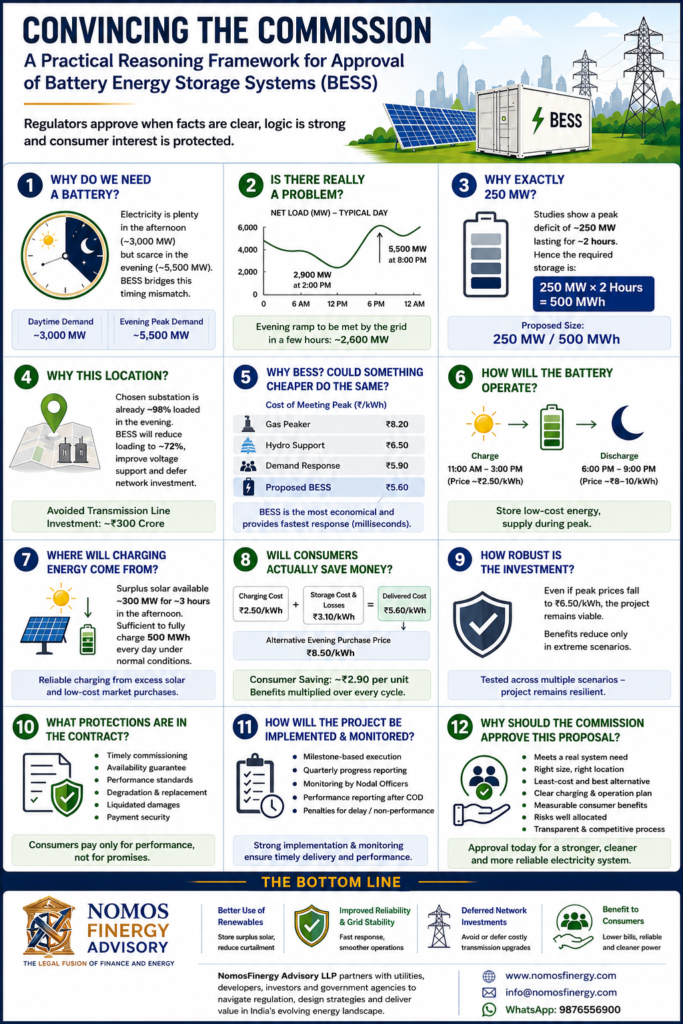
Suppose the State experiences a daytime demand of around 3,000 MW, while the evening demand rises to 5,500 MW. At the same time, rooftop solar generation is abundant during the afternoon but falls to almost zero after sunset.
This immediately creates a timing mismatch.
Electricity is plentiful when demand is low and scarce when demand is high.
The Commission is not approving a battery because it is fashionable; it is approving a solution to this operational problem.
Data must speak louder than arguments
Regulators are persuaded by evidence, not assumptions.
A well-prepared petition should therefore present hourly demand curves, renewable generation profiles, seasonal variations and net load curves.
Suppose the data show that between 2:00 PM and 8:00 PM, the net demand on the grid increases from 2,900 MW to 5,500 MW.
That means the system must suddenly arrange an additional 2,600 MW within a few hours.
Now the problem becomes measurable.
Instead of merely saying there is an evening peak, the petitioner has demonstrated its magnitude and operational impact.
Why exactly 250 MW?
One of the most common questions a Commission may ask is equally straightforward.
“Why have you proposed a 250 MW battery? Why not 150 MW? Why not 500 MW?”
The answer should emerge directly from system studies.
Suppose detailed analysis indicates that the expected peak deficit is approximately 250 MW, and that this shortage generally persists for two hours.
The required energy storage therefore becomes:
250 MW × 2 hours = 500 MWh
Suddenly, the proposed 250 MW / 500 MWh battery no longer appears arbitrary. It is a logical consequence of the system requirement.
Good regulatory decisions are rarely based on round numbers; they are based on demonstrated need.
Location matters as much as size
Another common misconception is that batteries can be installed anywhere.
In reality, location often determines value.
Suppose the proposed substation already operates at 98% loading during evening hours. A battery installed at this location could reduce peak loading to 72%, improve voltage support and postpone the need for a new transmission line costing several hundred crore rupees.
The Commission is no longer looking at the battery alone.
It is evaluating avoided network investment, improved reliability and better utilisation of existing infrastructure.
A battery is not the only solution
Before approving consumer-funded investment, every regulator should ask another important question.
“Is this the least-cost solution?”
Suppose alternative options are evaluated.
A gas-based peaking station may deliver electricity at ₹8.20 per unit.
Hydro support may cost ₹6.50 per unit.
Demand response programmes may cost ₹5.90 per unit.
The proposed BESS may deliver stored energy at ₹5.60 per unit, while also providing instantaneous response, renewable integration and transmission support.
Only after such comparison can the Commission conclude that battery storage is indeed the preferred option.
A battery does not generate electricity
Perhaps the most misunderstood aspect of BESS procurement is this.
A battery does not produce electricity.
It merely shifts electricity from one time to another.
Consequently, every BESS petition should clearly explain the charging philosophy.
Suppose surplus solar energy between 11:00 AM and 3:00 PM is available at approximately ₹2.50 per unit.
The battery stores this inexpensive energy and discharges it during the evening, when market prices frequently exceed ₹8 per unit.
Without a credible charging strategy, even the most competitively discovered storage tariff may fail to deliver consumer benefit.
Consumer benefit remains the ultimate test
Ultimately, every regulatory approval revolves around one fundamental principle.
Will consumers benefit?
Suppose charging costs ₹2.50 per unit.
After accounting for battery efficiency losses and storage charges, the delivered cost becomes approximately ₹5.60 per unit.
If the alternative evening purchase price is ₹8.50 per unit, the battery creates a saving of nearly ₹2.90 per unit.
When multiplied over hundreds of gigawatt-hours every year, the cumulative savings become substantial.
This is precisely the type of economic evidence that strengthens regulatory confidence.
Risk must be allocated before reward
The Commission should also ask a simple but important question.
“What happens if things go wrong?”
Who bears the cost if the battery degrades faster than expected?
Who is responsible if commissioning is delayed?
What happens if the guaranteed availability is not achieved?
A well-structured Battery Energy Storage Purchase Agreement (BESPA) should answer all these questions by clearly allocating technical, commercial and contractual risks between the developer and the procurer.
Consumers should never pay for risks that are within the developer’s control.
Beyond tariff approval
One of the most interesting developments in recent regulatory practice is that Commissions are no longer limiting themselves to tariff adoption.
They increasingly seek information regarding charging strategy, utilisation levels, implementation milestones, monitoring mechanisms and expected consumer benefits.
This demonstrates an important shift.
The Commission is not merely approving a tariff.
It is evaluating whether the proposed storage investment represents prudent, efficient and economically justified procurement.
The NomosFinergy Perspective
At NomosFinergy LLP, we believe that successful regulatory advocacy is built upon a simple principle.
Every question likely to arise in the Commission’s mind should already be answered in the petition.
A strong BESS approval petition should therefore establish, through evidence rather than assertion:
- Why the storage system is genuinely required.
- Why the proposed MW and MWh are technically justified.
- Why the selected location maximises system value.
- Why battery storage is preferable to available alternatives.
- How the charging strategy has been planned.
- How consumers will benefit financially.
- How contractual risks have been appropriately allocated.
- How implementation will be monitored throughout the project lifecycle.
When these questions are answered systematically, the petition evolves from being a regulatory filing into a comprehensive decision-support document for the Commission.
Conclusion
Battery Energy Storage Systems represent far more than a new technology. They represent a new way of planning, operating and regulating electricity systems.
For developers, utilities and consultants, the challenge is no longer simply preparing a petition under Section 63 of the Electricity Act. The real challenge is presenting a compelling technical, commercial and regulatory case that enables the Commission to conclude, with confidence, that the proposed investment serves the long-term interests of electricity consumers.
In the years ahead, the quality of regulatory reasoning may become just as important as the quality of battery technology itself.
And perhaps that is the real future of energy storage regulation in India.
About NomosFinergy LLP
NomosFinergy LLP is a specialised regulatory, commercial and market advisory firm focused on India’s evolving power sector. We advise utilities, developers, investors and government agencies on electricity market design, tariff strategy, regulatory approvals, power procurement, renewable integration, battery energy storage systems, carbon markets and commercial risk management. Our philosophy is simple: every regulatory proposal should combine sound engineering, rigorous economics and persuasive legal reasoning to create lasting value for consumers and stakeholders alike.
References & Further Reading
1. Kerala State Electricity Regulatory Commission (KSERC) Order
Approval of 250 MW / 500 MWh Grid-Scale Battery Energy Storage System (Brahmapuram), Adoption of Tariff under Section 63 and Approval of BESPA (Order dated 12 June 2026).
KSERC Order – 250 MW / 500 MWh BESS at Brahmapuram (12.06.2026)
This is the principal order discussed in the article and contains:
- Need assessment for BESS
- Duck curve observations
- Tariff adoption
- BESPA approval
- Commission’s observations on charging energy
- Directions regarding utilisation and monitoring
2. Electricity Act, 2003
The statutory framework governing:
- Section 63 (Adoption of tariff through competitive bidding)
- Section 86(1)(b) (Power procurement by Distribution Licensees)
- Section 2(50) (Definition of “Power System”)
- Overall regulatory framework for electricity procurement.
Electricity (Amendment) Rules, 2022
These Rules formally recognised Energy Storage Systems (ESS) within India’s electricity regulatory framework and clarified that an ESS forms part of the power system and may function as a generation, transmission or distribution asset depending on its application.
Electricity (Amendment) Rules, 2022 (Official Notification)