
Why QCA and BESS Should Become Part of Renewable Project Feasibility
Why forecasting, aggregation and storage should be considered before—not after—the renewable bid
The economics of renewable power projects are changing.
For years, renewable project feasibility has largely revolved around resource assessment, land, evacuation, capital cost, financing, generation profile, PPA terms and the resulting Levelised Cost of Energy (LCOE).
But the question facing a renewable developer is no longer simply:
What does it cost to generate electricity?
It is increasingly:
What does it cost to reliably deliver the contracted electricity while complying with the applicable scheduling, forecasting and deviation-settlement framework?
This distinction can materially affect the economics of a renewable bid.
The increasing importance of Qualified Coordinating Agencies (QCA), forecasting and scheduling, Deviation Settlement Mechanism (DSM) exposure and Battery Energy Storage Systems (BESS) suggests that these elements should increasingly form part of the initial project feasibility and bid-optimisation exercise.
1. QCA is not new—but its commercial importance is increasing
QCA is already part of the regulatory architecture for renewable projects at the inter-State level. Under the CERC framework, a QCA can coordinate scheduling and undertake commercial settlement of deviations on behalf of renewable generating stations and Energy Storage Systems.
What is becoming particularly interesting is the increasing relevance of the same concept at the intra-State level.
The proposed UERC DSM Regulations, 2026 specifically define QCA for renewable generators, renewable hybrid generating stations and systems including ESS connected to one or more pooling stations. The proposal provides for registration of the QCA with the SLDC and assigns it functions relating to scheduling, coordination with STU/SLDC, commercial settlement and de-pooling of deviation charges.
Importantly, the proposed UERC framework also expressly recognises aggregation of WS sellers at a pooling station through QCA, including weighted-average contract rates and an agreed methodology for de-pooling deviation charges.
The implication is significant.
While QCA should not be described as a new regulatory requirement, intra-State QCA-based aggregation may increasingly become an important part of renewable project design and commercial arrangements as State-level DSM frameworks evolve.
2. QCA should be treated as an economic variable
A QCA is often viewed as a compliance and operational arrangement.
From a project-finance perspective, however, it can also have an economic value.
Aggregation can potentially reduce the net deviation exposure of a portfolio because generation deviations from different projects may partially offset each other.
But QCA itself is not free.
There may be costs associated with forecasting, scheduling, data infrastructure, communication, metering, operational coordination and the QCA’s commercial service.
Therefore, the relevant relationship is:
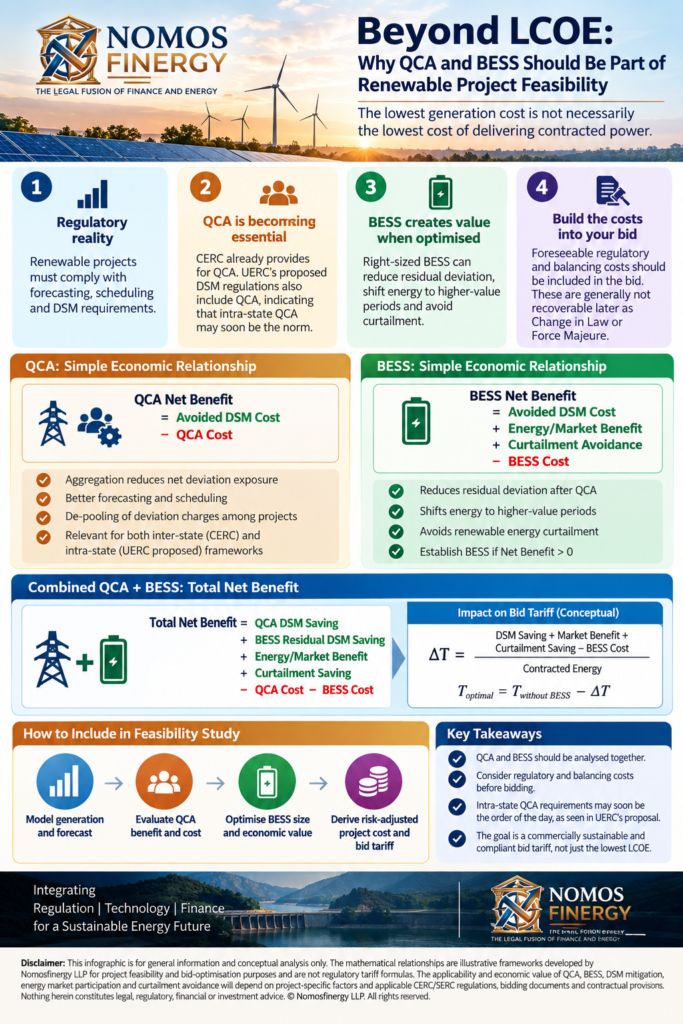
QCA Net Benefit = Avoided DSM Cost − QCA Cost
The important question is not whether QCA is beneficial in the abstract.
It is:
Does the reduction in expected DSM exposure exceed the cost of establishing and operating the QCA arrangement?
That calculation should be made at the project-feasibility stage.
3. BESS should also be evaluated as an economic proposition
BESS is frequently considered simply as an additional capital cost.
That approach can be misleading.
Depending on the project and PPA structure, BESS may create value by:
- reducing residual DSM exposure;
- shifting energy to higher-value periods; and
- reducing renewable energy curtailment.
Accordingly, a simple project-level relationship can be expressed as:
BESS Net Benefit = Avoided DSM Cost + Energy/Market Benefit + Curtailment Avoidance − BESS Cost
The decision rule is straightforward:
Establish BESS if BESS Net Benefit > 0
This does not mean that every renewable project should install BESS.
It means that the BESS decision should be based on project-specific economic analysis, rather than treating storage as either automatically necessary or automatically uneconomic.
4. QCA and BESS should be optimised together
This is where the feasibility model becomes more interesting.
QCA and BESS should not necessarily be assessed independently.
If QCA aggregation reduces the project’s deviation exposure, the BESS requirement may also reduce.
Conversely, BESS can manage the residual deviation and variability remaining after aggregation.
Therefore, the combined analysis should avoid double-counting the same DSM saving.
The conceptual relationship can be expressed as:
Total Net Benefit = QCA DSM Saving + BESS Residual DSM Saving + Energy/Market Benefit + Curtailment Saving − QCA Cost − BESS Cost
This is a much more useful way of looking at the problem than simply asking:
“Should we install BESS?”
The real question is:
What combination of renewable capacity, QCA aggregation and BESS provides the most economically efficient way of delivering the contracted power?
5. The implication for the bid tariff
Once QCA and BESS are incorporated into the feasibility model, they can affect the economically sustainable bid tariff.
For example, the BESS-related tariff impact can be represented conceptually as:
ΔT(BESS) = [DSM Saving + Market Benefit + Curtailment Saving − BESS Cost] ÷ Contracted Energy
and:
T(optimal) = T(without BESS) − ΔT(BESS)
This is not a regulatory tariff formula.
It is a project-finance relationship designed to answer a practical commercial question:
Does the investment in flexibility reduce the effective cost of delivering the contracted renewable energy sufficiently to justify that investment?
The same principle can be applied to the QCA arrangement by comparing the expected DSM saving against the cost of aggregation and coordination.
6. Why this analysis should happen before bidding
This is perhaps the most important message for renewable developers.
Once a bid is submitted, the bid tariff becomes the foundation of the project’s commercial model.
If a regulatory or operational requirement is already known or reasonably foreseeable at the time of bidding, a developer should not build its financial model on the assumption that the resulting cost can subsequently be passed through to the procurer merely by invoking Change in Law or Force Majeure.
Whether a particular cost qualifies under either provision will always depend on the applicable law, regulation, contractual language, timing and facts.
But the commercial lesson is straightforward:
Known regulatory and balancing risks should be priced into the project before the bid is submitted.
The recent evolution of DSM regulation reinforces this point. CERC’s current regulatory framework contains specific provisions for renewable deviation settlement, while the regulatory architecture continues to evolve around renewable forecasting, scheduling and deviation management.
Therefore, a developer should not ask after award:
“How will we manage this additional cost?”
The question should have been asked before bidding:
“Have we already priced this risk into our bid?”
7. From LCOE to the real cost of delivering renewable power
Traditionally, a renewable project is evaluated primarily on its LCOE and expected return.
But a project may have a low generation cost and still become commercially unattractive if it incurs significant costs for forecasting errors, DSM deviations, curtailment or the flexibility required to meet its contractual obligations.
Therefore, LCOE alone should not be the basis for determining the bid tariff.
Before submitting a bid, the developer should model the complete delivery chain:
Generation Profile → Forecasting → QCA Aggregation → DSM Exposure → BESS Requirement → Curtailment → Market/Energy Value → PPA Settlement → Project Cash Flow
The analysis should answer three basic questions:
- What will it actually cost to deliver the contracted energy?
- How much DSM exposure can be reduced through QCA aggregation?
- Can BESS economically manage the residual exposure and create additional value?
The outcome should be an economically sustainable project configuration and bid tariff, rather than a tariff based only on conventional LCOE.
In other words:
The relevant metric is not simply “What does it cost to generate renewable power?” but “What does it cost to reliably deliver the contracted renewable power under the applicable regulatory and contractual framework?”
8. Why intra-State QCA deserves particular attention
The UERC proposal is important in this context because it demonstrates that QCA-based coordination is not confined to the inter-State framework.
The proposed regulations cover state-grid-connected entities and intra-State purchase and sale of electricity, while separately recognising the applicability of CERC’s DSM framework to renewable generating stations directly connected to the inter-State transmission network and supplying power outside the State.
The proposed framework also specifically contemplates WS sellers aggregated through QCA and sets out how deviation charges and de-pooling would operate.
This points towards a broader commercial possibility:
As State DSM frameworks mature, QCA-based aggregation at the intra-State level may increasingly become part of the standard architecture for managing renewable portfolios.
For developers planning projects today, that possibility deserves to be considered in the feasibility model rather than ignored until the project reaches commercial operation.
9. A new approach to renewable project feasibility
The conventional feasibility model can therefore be expanded without making it unnecessarily complicated.
The basic structure is:
Renewable Resource
↓
Generation & Forecasting
↓
QCA Economics
↓
Residual DSM Exposure
↓
BESS Economics
↓
Curtailment & Market Value
↓
PPA / Contractual Settlement
↓
Project Cash Flow
↓
Optimal Configuration & Bid Tariff
The objective is not to maximise the size of BESS.
It is not to minimise DSM at any cost.
Nor is it simply to minimise LCOE.
The objective is to identify the lowest-cost configuration capable of delivering the contracted renewable energy while managing the project’s regulatory and operational exposure.
10. The Nomosfinergy perspective
The renewable power market is moving towards a situation where regulation, technology and finance can no longer be analysed independently.
Regulation determines the obligations.
Forecasting and QCA determine how the renewable portfolio manages those obligations.
BESS can provide flexibility against the residual variability.
Financial modelling determines whether the resulting configuration is commercially viable.
Consequently, QCA and BESS should increasingly be treated as project-feasibility variables rather than post-award operational decisions.
The central message is simple:
The cheapest renewable generation configuration is not necessarily the cheapest compliant delivery configuration.
A bid that looks attractive on the basis of LCOE may produce a very different outcome once DSM exposure, QCA costs, BESS requirements, curtailment and market value are properly modelled.
Therefore, before submitting a renewable bid, the developer should know not only:
“What is my LCOE?”
but also:
“What is my risk-adjusted cost of delivering the contracted power?”
That is where QCA and BESS move from being operational considerations to becoming integral elements of renewable project feasibility and bid strategy.
Nomosfinergy LLP
Regulatory Strategy | Power Markets | Financial & Commercial Advisory
Disclaimer
This article is intended solely for general information, professional discussion and conceptual analysis. The mathematical relationships presented herein are analytical frameworks developed by Nomosfinergy LLP for project-feasibility and bid-optimisation purposes and are not prescribed regulatory tariff formulas or methodologies.
References to the UERC DSM framework relate to the 2026 draft/proposed regulations and should not be construed as representing a final regulatory position unless and until notified by the Commission.
The actual economic value of QCA, BESS, DSM mitigation, energy-market participation and curtailment avoidance will depend on the specific project configuration, applicable CERC/SERC regulations, bidding documents, PPA/TSA provisions, grid conditions, forecasting performance, market prices, financing assumptions and other project-specific factors.
The discussion regarding Change in Law and Force Majeure is general in nature. Whether any particular cost or event qualifies for relief, compensation or pass-through must be determined from the applicable law, regulations, contractual provisions and facts of the individual case. Nothing in this article constitutes legal, regulatory, financial, investment or bidding advice.
© Nomosfinergy LLP. All rights reserved.