
Your Appointment Is No Longer a Shield—It Is a Responsibility
For many years, accepting an appointment as an Independent Director was viewed as a prestigious culmination of a professional career. Companies sought eminent individuals to satisfy statutory requirements while simultaneously enhancing the credibility of their boards. Many Independent Directors, in turn, assumed that because they were not involved in the day-to-day management of the company, their legal exposure was inherently limited.
That assumption is becoming increasingly difficult to sustain.
Over the last few years, Indian corporate governance has entered a new phase. Judicial pronouncements of the Supreme Court, regulatory actions by the Securities and Exchange Board of India (SEBI), decisions of the Securities Appellate Tribunal (SAT), and an increasing emphasis on accountability under the Companies Act, 2013, collectively indicate a significant shift in expectations from Independent Directors.
The law continues to recognize that Independent Directors are not responsible for managing the affairs of a company. Equally, however, it expects them to exercise informed oversight, independent judgment and demonstrable diligence. The statutory protection available under Section 149(12) of the Companies Act, 2013 is not an absolute immunity. It is a carefully designed safeguard that operates only where an Independent Director can demonstrate that the alleged act or omission did not occur with his or her knowledge through Board processes, consent, connivance, or failure to act diligently.
In practical terms, the legal question has changed from:
“Were you managing the company?”
to
“When warning signs were visible, what exactly did you do?”
Increasingly, regulators and courts are examining not merely whether Independent Directors attended Board meetings, but whether they actively questioned management, sought clarification, exercised independent judgment, and ensured that their concerns were appropriately recorded.
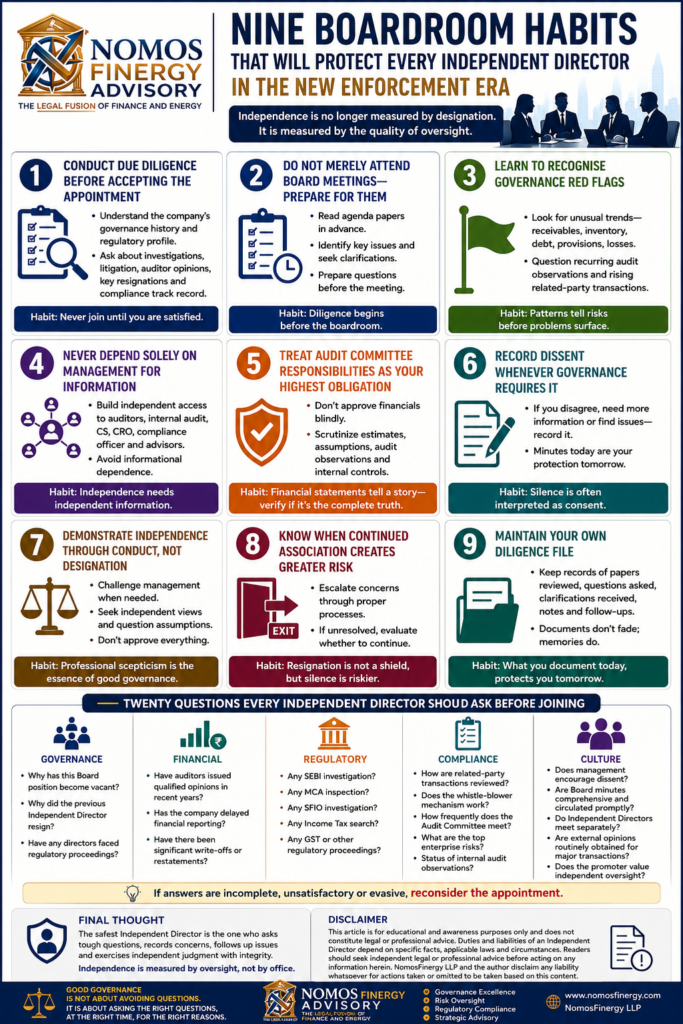
The modern Independent Director must therefore move beyond passive oversight. The following nine boardroom habits represent practical governance disciplines that significantly strengthen both the effectiveness of the Board and the legal position of Independent Directors.
1. Conduct Due Diligence Before Accepting the Appointment
The first responsibility of an Independent Director begins before joining the Board.
Many distinguished professionals spend considerable time evaluating investments or acquisitions, yet accept Board positions based solely on reputation or personal acquaintance. In today’s enforcement environment, that approach exposes unnecessary risk.
Before accepting an appointment, seek clear answers to the following:
- Why has the position become vacant?
- Why did the previous Independent Director resign?
- Has the company been subjected to investigations by SEBI, MCA, SFIO, RBI, GST or Income Tax authorities?
- Are there any pending regulatory proceedings, prosecutions or material litigation?
- Have statutory auditors issued qualified opinions during the previous three financial years?
- Have there been frequent resignations of auditors, Chief Financial Officers, Company Secretaries or other Key Managerial Personnel?
A company’s willingness—or unwillingness—to answer these questions often provides valuable insight into its governance culture.
Boardroom Habit: Never accept an Independent Directorship until you are satisfied with the company’s governance history and regulatory profile.
2. Do Not Merely Attend Board Meetings—Prepare for Them
An Independent Director’s diligence begins well before entering the Board room.
Agenda papers should be reviewed thoroughly. Significant transactions, unusual financial movements, related-party dealings and major capital commitments should be examined in advance. Clarifications should be sought wherever necessary.
Independent judgment cannot be exercised without adequate preparation.
A director who first studies the agenda while sitting in the Board meeting has already compromised the very independence expected by law.
Ask Yourself Before Every Meeting:
- What decisions require deeper scrutiny?
- What assumptions has management made?
- Which issues deserve further explanation?
3. Learn to Recognise Governance Red Flags
Corporate failures rarely begin with spectacular fraud.
They usually begin with unexplained inconsistencies.
Every quarter, an Independent Director should critically examine trends rather than isolated numbers.
Questions worth asking include:
- Why have trade receivables increased disproportionately?
- Why has inventory grown despite stagnant revenues?
- Why has borrowing increased while profitability has declined?
- Why have auditors repeatedly highlighted similar observations?
- Why are related-party transactions increasing?
- Why are provisions or write-offs rising?
Independent Directors are not expected to detect fraud.
They are expected to recognise patterns that warrant further inquiry.
4. Never Depend Solely on Management for Information
An Independent Director who receives all information exclusively through the Managing Director or Promoter gradually loses practical independence.
Develop independent channels of communication with:
- Statutory Auditors
- Internal Auditors
- Company Secretary
- Chief Risk Officer
- Compliance Officer
- External Advisors, where appropriate
Periodic interaction with these stakeholders provides a broader understanding of governance issues and reduces informational dependence.
Boardroom Habit: Independence is sustained through independent access to information.
5. Treat Audit Committee Responsibilities as Your Highest Governance Obligation
Recent regulatory actions clearly indicate that Independent Directors serving on Audit Committees will be subjected to greater scrutiny.
Financial statements should never be approved merely because they carry the auditor’s signature.
Instead, ask:
- What accounting estimates significantly affect the results?
- Which assumptions have management adopted?
- Are there unresolved audit observations?
- Which transactions required exceptional judgment?
- Have internal control weaknesses been adequately addressed?
Financial statements narrate the company’s story.
The Independent Director’s responsibility is to determine whether that story is complete, transparent and credible.
6. Record Dissent Whenever Governance Requires It
One of the greatest misconceptions among Independent Directors is that remaining silent protects them.
Experience demonstrates the opposite.
If you disagree—
record it.
If additional information is required—
record it.
If management declines disclosure—
record it.
If legal advice is recommended—
record it.
Years later, investigators and adjudicating authorities rarely rely upon recollections of discussions.
They examine the Board minutes.
A carefully reasoned dissent or recorded request for clarification frequently becomes the strongest evidence that an Independent Director exercised due diligence.
7. Demonstrate Independence Through Conduct, Not Designation
True independence is measured by behaviour.
Every Independent Director should periodically reflect:
- Have I challenged management when necessary?
- Have I ever requested additional information before approving a proposal?
- Have I insisted on independent valuation or legal opinion?
- Have I questioned assumptions underlying major transactions?
- Have I expressed disagreement where appropriate?
If every Board resolution receives unanimous approval throughout a director’s tenure, regulators may legitimately question whether genuine independent judgment was exercised.
Professional scepticism is not confrontation.
It is the essence of good governance.
8. Know When Continued Association Creates Greater Risk Than Resignation
Resignation should never be the first response to governance concerns.
Neither should continued silence become the default response.
If repeated concerns remain unresolved despite:
- Board discussions,
- Audit Committee deliberations,
- recorded objections,
- requests for independent review,
- legal advice,
an Independent Director must objectively evaluate whether continued association exposes him or her to unacceptable legal risk.
Resignation alone does not eliminate liability.
However, remaining associated with persistent governance failures without meaningful intervention may significantly weaken statutory protection.
9. Maintain Your Own Diligence File
Perhaps the most practical safeguard available to every Independent Director is maintaining a personal record of diligence.
Such a file may contain:
- Board papers reviewed;
- Questions raised before meetings;
- Clarifications received from management;
- Personal notes prepared contemporaneously;
- Audit Committee observations;
- Independent legal or technical opinions obtained;
- Follow-up actions requested.
Years later, memories fade.
Documents remain.
The ability to demonstrate diligence often depends not upon recollection but upon contemporaneous records.
Before You Join Any Board: Twenty Questions Every Independent Director Should Ask
The quality of an Independent Director’s tenure often depends upon the quality of questions asked before accepting the appointment.
Governance
- Why has this Board position become vacant?
- Why did the previous Independent Director resign?
- Have any directors faced regulatory proceedings?
Financial
- Have auditors issued qualified opinions in recent years?
- Has the company delayed financial reporting?
- Have there been significant write-offs or restatements?
Regulatory
- Is the company facing any investigation by SEBI?
- Has the Ministry of Corporate Affairs initiated any inspection?
- Has SFIO conducted or initiated any investigation?
- Are there significant proceedings under GST, Income Tax or other regulatory laws?
Compliance
- How are related-party transactions reviewed?
- Does the whistle-blower mechanism function effectively?
- How frequently does the Audit Committee meet?
- What are the company’s top enterprise risks?
- What is the status of internal audit observations?
Governance Culture
- Does management encourage dissenting opinions?
- Are Board minutes comprehensive and circulated promptly?
- Do Independent Directors meet separately without management?
- Are external legal or technical opinions routinely obtained for significant transactions?
- Does the promoter genuinely value independent oversight?
If these questions are met with hesitation, incomplete answers or resistance, an Independent Director should carefully reconsider whether the Board offers an environment where independent judgment can realistically be exercised.
Final Thoughts
The role of an Independent Director has entered a new era.
Appointment to the Board is no longer a ceremonial recognition of professional achievement. It is an acceptance of fiduciary responsibility accompanied by increasing regulatory scrutiny.
The safest Independent Director is not the individual who approves every proposal, attends every meeting or avoids disagreement.
Rather, it is the director who consistently asks informed questions, demands credible explanations, records legitimate concerns, follows up unresolved issues and exercises independent judgment with courage and integrity.
Ultimately, statutory protection under the Companies Act is not preserved by designation alone. It is preserved by demonstrable diligence.
In today’s corporate governance landscape, independence is no longer measured by the manner of appointment. It is measured by the quality of oversight.
Disclaimer
This article is intended solely for educational, professional awareness and knowledge-sharing purposes. It provides a general discussion of the legal and governance responsibilities of Independent Directors under the Companies Act, 2013, relevant rules, the SEBI (Listing Obligations and Disclosure Requirements) Regulations, 2015, and selected judicial and regulatory precedents as available on the date of publication.
The views expressed herein are intended to promote sound corporate governance practices and should not be construed as legal advice, regulatory opinion or a substitute for professional consultation. The duties, responsibilities and potential liabilities of an Independent Director depend upon the specific facts, the applicable statutory framework, the company’s constitutional documents, and the circumstances of each case.
Readers are advised to seek independent legal, regulatory or professional advice before acting upon any information contained in this article.
NomosFinergy LLP and the author disclaim any liability for actions taken or omitted to be taken based on this publication. While every effort has been made to ensure the accuracy of the legal principles discussed, the law is continually evolving through legislative amendments, judicial interpretation and regulatory developments, and readers should refer to the latest applicable legal provisions and authoritative pronouncements.